
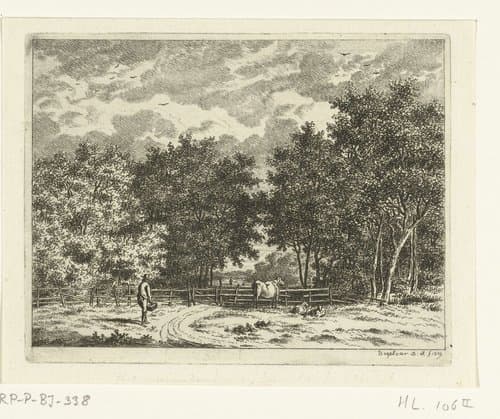
Weiland met een koe en twee schapen
Medium
etching
Dimensions
96; 122
Rights
Public Domain
About this artwork
plaatrand: hoogte 96 mm x breedte 122 mm
Art Historical Context
Ernst Willem Jan Bagelaar’s 1819 etching *Weiland met een koe en twee schapen* captures a tranquil pastoral moment in just a few square inches. Measuring only 96 by 122 millimetres, the print presents a modest meadow occupied by a single cow and two sheep, rendered with the fine, economical lines characteristic of early-nineteenth-century Dutch etching. The compact format suggests the work was intended for intimate viewing, perhaps as part of a collector’s album or portfolio of rural studies. Etching allowed Bagelaar to achieve delicate tonal gradations and precise detail while remaining reproducible, a technique that continued the long Dutch tradition of printmaking as both artistic expression and accessible documentation of the countryside. The quiet subject matter reflects the period’s renewed appreciation for unassuming nature scenes following the upheavals of the Napoleonic wars, when artists often turned to familiar local landscapes for reassurance and national identity. Though small in scale, the print rewards close looking: subtle variations in line weight convey the texture of fleece and grass, demonstrating how even the most ordinary motif could be elevated through careful observation and technical skill.
About the Artist
Ernst Willem Jan Bagelaar · 1775–1837
Ernst Willem Jan Bagelaar (1775–1837) was a Dutch military officer and artist whose dual career exemplified the accomplished amateur tradition in European art. Born on September 16, 1775, in Eindhoven, Bagelaar first entered military service, eventually reaching the rank of colonel (overste), but early developed a strong interest in the fine arts. Though largely self-taught in etching, he acquired...