
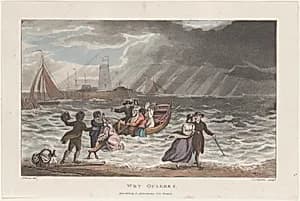
Wet Quakers
Medium
Hand-colored etching and aquatint
Dimensions
Sheet: 5 5/8 × 8 7/16 in. (14.3 × 21.4 cm)
Classification
Prints
Department
Drawings and Prints
Museum
Metropolitan Museum of Art, New York, NY
Credit
The Elisha Whittelsey Collection, The Elisha Whittelsey Fund, 1959
Accession Number
59.533.1620(21)
Rights
Public Domain
Tags
Art Historical Context
Created in 1813 by the celebrated British caricaturist Rowlandson and published by Rudolph Ackermann in London with assistance from James Green, "Wet Quakers" is a lively hand-colored etching and aquatint that captures the playful spirit of early nineteenth-century satirical printmaking. Rowlandson was renowned for his witty observations of British social life, and this small sheet—measuring just over five by eight inches—demonstrates the popular technique of etching combined with aquatint, which allowed artists to achieve tonal effects and then add vibrant watercolor by hand for wide distribution. The title and tags suggest a humorous boating scene involving men and women associated with the Quaker community, likely portraying an unexpected mishap on the water. Such imagery reflects the era’s fascination with gentle social satire, poking fun at religious groups and everyday mishaps alike while appealing to a broad audience through affordable prints. Today housed in the Metropolitan Museum of Art’s Department of Drawings and Prints as part of the Elisha Whittelsey Collection, the work offers modern viewers a charming window into Regency-era humor and the lively tradition of caricature that shaped public discourse.
About the Artist
Thomas Rowlandson|Rudolph Ackermann, London|James Green · 1756–1827
Thomas Rowlandson (1757–1827) was an English artist and caricaturist whose satirical watercolors and prints captured the social life of Georgian Britain with unparalleled wit and technical mastery. Alongside James Gillray, he is recognized as one of the greatest British graphic artists, and his distinctive flowing line and keen observations have made his work integral to understanding late 18th an...