
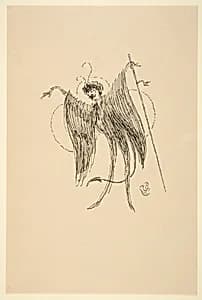
Whistler as Butterfly
19th–20th century
Medium
Commercial relief process
Dimensions
sheet: 9 x 5 15/16 in. (22.9 x 15.1 cm)
Classification
Prints
Department
Drawings and Prints
Museum
Metropolitan Museum of Art, New York, NY
Credit
Gift of Paul F. Walter, 1985
Accession Number
1985.1161.37
Rights
Public Domain
Art Historical Context
James McNeill Whistler, the celebrated 19th-century artist known for his Aestheticist principles and subtle tonal harmonies, immortalized his persona in *Whistler as Butterfly*, a delightful print from the late 19th to early 20th century. small-scale work (9 x 5 15/16 inches) captures Whistler's iconic butterfly monogram—a whimsical self-symbol he developed around 1860. The motif, with its stylized 'J', flowing 'M' wings, and 'W' tail, represented his artistic identity, evoking grace, ephemerality, and the "art for art's sake" ethos that defined his career alongside works like *Arrangement in Grey and Black No.1* (Whistler's Mother). Produced via a commercial relief process—a technique leveraging mechanical printing for precise, reproducible images—this print highlights Whistler's embrace of printmaking as a democratic medium. Unlike his ethereal paintings and etchings, it reflects the era's advancements in mass production, bridging fine art with broader accessibility. Housed in the Metropolitan Museum of Art's Drawings and Prints department (gift of Paul F. Walter, 1985), it offers a playful glimpse into the artist's self-fashioning. Visitors will appreciate how this piece embodies Whistler's flair for the poetic and personal, transforming a signature into a portrait of creative spirit.
About the Artist
James McNeill Whistler · 1834–1903
James Abbott McNeill Whistler (1834-1903) was an American-born painter and printmaker who became a leading figure in the Aesthetic Movement and pioneer of Tonalism and Japonisme. He revolutionized art by championing "art for art's sake" and treating paintings as visual equivalents of musical compositions, titling works as "arrangements," "harmonies," and "nocturnes" to emphasize formal qualities o...