
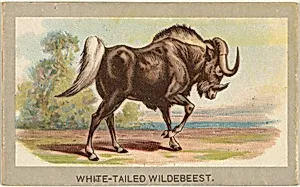
White-Tailed Wildebeest, from the Animals of the World series (T180), issued by Abdul Cigarettes
1881
Medium
Commercial color lithograph
Dimensions
Sheet: 1 5/8 × 2 3/4 in. (4.2 × 7 cm)
Classification
Prints|Ephemera
Department
Drawings and Prints
Museum
Metropolitan Museum of Art, New York, NY
Credit
The Jefferson R. Burdick Collection, Gift of Jefferson R. Burdick
Accession Number
63.350.246.180.29
Rights
Public Domain
Tags
Art Historical Context
Step into the vibrant world of 19th ephemera with *White-Tailed Wildebe* from the *Animals of World* series (T), issued by Abdul Cig in 1881. This petite commercial color lithograph, just 1 5/8 × 2 3/4 inches, captures the majestic African gnu in intricate detail, showcasing its distinctive white tail and robust form. Part of a popular series tucked into cigarette packs, these turned everyday smoking into a gateway for armchair exploration of global wildlife, education with marketing savvy. Chromolithography, the medium here, revolutionized printing in the Victorian era by layering vibrant colors through multiple lithographic stones—a technique that made high-quality, affordable images accessible to the masses. No longer reserved for fine art, it fueled the collectibles boom, with sets like T180 inspiring enthusiasts to trade and complete albums. This card exemplifies how commerce intertwined with curiosity, popularizing natural history at a time when zoos and expeditions fueled public fascination with exotic animals. Housed in the Metropolitan Museum of Art's Jefferson R. Burdick Collection—a treasure trove of over 30,000 American trade cards gifted in 1948—this unassuming print highlights ephemera's enduring artistic value. Today, it reminds us how tiny tokens preserved big dreams of discovery.
About the Artist
Abdul Cigarettes · 1881–1881
Abdul Cigarettes, an enigmatic American entity active solely in 1881, stands as a fascinating footnote in the history of commercial art, best known for producing vibrant chromolithograph trade cards inserted into cigarette packages as promotional inserts. Little is documented about its origins or personnel, suggesting it operated as a short-lived publishing venture rather than the work of a singul...