
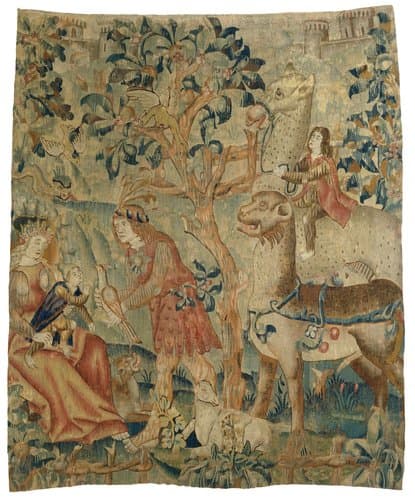
Wildemannen en dieren in een landschap (fragment)
ca. 1500 - ca. 1520
Medium
tapestry
Dimensions
217; 262
Rights
Public Domain
About this artwork
…; sale, Raoul Heilbronner (1847-1941, Paris), Paris (Drouot), 9 (exact day unknown) November 1921 sqq., no. 516;…; collection Dr Fritz Mannheimer (1890-1939), Amsterdam and Paris, before 1933;{Photo album ‘Het huis van Dr F. Mannheimer, Amsterdam’, 1928-32, Rijksmuseum, inv. no. B-F-1963-426-10.} from whom, fl. 6,350,000, en bloc, to Artistic & General Securities Ltd. as security for a loan from the Mendelssohn & Co. Bank, but kept in usufruct, 1934;{NHA, 476, RMA Archive, inv. no. 2142, Recapi...
Art Historical Context
This striking tapestry fragment, *Wildemannen en dieren een landschap* ("Wild Men and Animals in a Landscape dates to around 1500–1520 and was created by an anonymous artist, likely in a Northern European workshop such as those in the Low Countries. Measuring an impressive 262 × 217 cm, it a fantastical scene of wild men—mythical figures symbolizing untamed nature and primal strength—amidst animals in a lush landscape. Tapestries like this were prestige objects for elite homes and castles, woven from wool and silk with intricate techniques that could take years, blending artistry with storytelling from medieval folklore. The wild man motif, rooted in late Gothic and early Renaissance traditions, evoked the boundary between civilization and wilderness, often appearing in decorative arts to decorate halls or chambers. As a fragment, it hints at a larger narrative weave, showcasing the era's vibrant dyes, detailed figural weaving, and imaginative compositions that bridged symbolism and decoration. Its provenance adds poignant history: once in the collection of Dr. Fritz Mannheimer, it was acquired by the Nazis in 1940 for Adolf Hitler's planned Führermuseum in Linz, before postwar recovery by the Dutch SNK in 1945 and eventual transfer to the Rijksmuseum in 1960. This journey underscores the tapestry's survival through war and restitution, making it a testament to cultural resilience.
About the Artist
anonymous
In the vast tapestry of art history, "Anonymous" stands not as a singular individual but as a collective designation for countless unidentified creators whose works have endured across millennia. These artists, spanning prehistoric cave painters to medieval illuminators and folk craftsmen, produced the foundational layers of human visual culture. Prior to the Renaissance, when individual fame emer...