
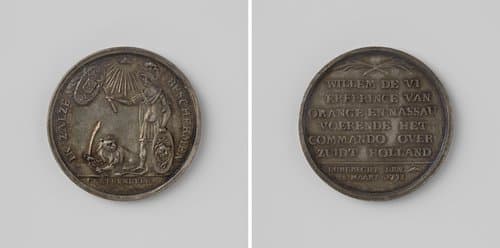
Willem VI, erfprins van Oranje-Nassau aanvaardt het commando over Zuid-Holland
1793
Medium
striking (metalworking)
Dimensions
3.2; 12.69
Rights
Public Domain
About this artwork
Zilveren penning. Voorzijde: beschenen door alziend oog in starelnde driehoek houdt Willem VI, afgebeeld als Mars wapenschild en commandostaf in handen; naast hem leeuw met pijlenbundel en zwaard; hand uit wolken reikt prins wapenschild binnen omschrift; afsnede: signatuur. Keerzijde: opschrift onder twee gekruiste palmtakken; afsnede: datering
Art Historical Context
This exquisite silver medal, struck by Dutch artist Gerrit Steenbeek 1793, commemorates a pivotal moment: Willem VI, heir prince of Orange-Nassau, accepting over South Holland. Measuring just 3.2 cm in diameter and weighing 12.69 grams, this intimate metalwork exemplifies the artistry of commemorative medallions from the late 18th century. The obverse portrays the prince as the Roman god Mars, bathed in divine light from an all-seeing eye within a radiant triangle, clutching a coat of arms and command staff. Flanking him is the heraldic Dutch lion bearing a bundle of arrows—symbolizing unity—and a sword, while a heavenly hand extends the shield, evoking providence's favor. Steenbeek's signature graces the edge, underscoring his mastery of fine engraving. Crafted amid the turmoil of the French Revolutionary Wars, the medal reflects patriotic fervor in the Dutch Republic. South Holland, a key province, faced threats from French invaders and internal Patriot unrest; Willem's assumption of command rallied Orangist loyalists against republican challengers, foreshadowing the 1795 Batavian Revolution. Such medals served as portable propaganda, worn or shared to boost morale and loyalty. Artistically, Steenbeek's technique—precise striking on silver—captures intricate details and symbolism, blending neoclassical allegory with Dutch iconography. The reverse, with its inscription beneath crossed palm branches denoting victory and peace, invites reflection on resilience. A tiny treasure, it offers visitors a tangible glimpse into an era of political drama and national identity.