
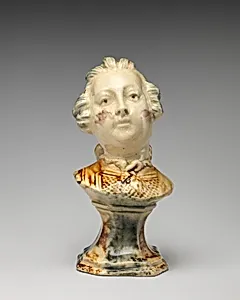
William Augustus, Duke of Cumberland
Medium
Lead-glazed earthenware
Dimensions
Height: 6 3/4 in. (17.1 cm)
Classification
Ceramics-Pottery
Culture
British, Staffordshire
Department
European Sculpture and Decorative Arts
Museum
Metropolitan Museum of Art, New York, NY
Credit
Gift of Josephine Atterbury, 1945
Accession Number
45.13.2
Rights
Public Domain
Tags
Art Historical Context
This delightful bust captures William Augustus, Duke of (1721–1765), the third son of King George II and a prominent British military leader. Best known for his decisive victory at the Battle of Cull in 1746, which crushed the Jacobite uprising, Cumberland became a symbol of Hanoverian triumph and Protestant loyalty—though reviled in Scotland as the "Butcher." Crafted around 1750, this intimate portrait reflects the era's fascination with heroic figures, immortalizing him in miniature for admirers' homes. Made of lead-glazed earthenware from Staffordshire, England—a hub of innovative pottery production—this 6¾-inch (17.1 cm) sculpture exemplifies affordable decorative arts. The glossy lead glaze enhances the bust's lifelike details, from the duke's resolute expression to his military wig and armor. Attributed to leading sculptors Louis François Roubiliac and John Michael Rysbrack, both renowned for grand marble and terracotta portraits, it likely draws from their models, adapted by Staffordshire potters into accessible ceramics. Housed in the Metropolitan Museum of Art's European Sculpture and Decorative Arts department (gift of Josephine Atterbury, 1945), this piece highlights 18th-century Britain's blend of fine art and popular culture, making elite portraiture available to the middle class.