
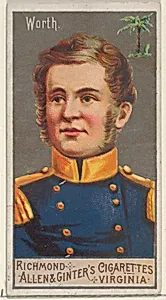
William Jenkins Worth, from the Great Generals series (N15) for Allen & Ginter Cigarettes Brands
Medium
Commercial color lithograph
Dimensions
Sheet: 2 3/4 x 1 1/2 in. (7 x 3.8 cm)
Classification
Prints|Ephemera
Department
Drawings and Prints
Museum
Metropolitan Museum of Art, New York, NY
Credit
The Jefferson R. Burdick Collection, Gift of Jefferson R. Burdick
Accession Number
63.350.201.15.50
Rights
Public Domain
Tags
Art Historical Context
In the late 19th century, tobacco companies like Allen & Ginter revolutionized marketing by inserting collectible cards into cigarette packs, sparking a craze for trading and album-building among enthusiasts. This petite commercial color lithograph, in 1888 by George S Harris & Sons, features William Jenkins Worth (1794–1849), a celebrated U.S. Army general known for his valor in the War of 1812 and the Mexican-American War, where he captured key sites like Chapultepec. Part of the "Great Gener series (N15)," it honors military heroes during a post-Civil War era of national pride and nostalgia for wartime leaders. Measuring just 2¾ × 1½ inches, this ephemera exemplifies chromolithography's vibrancy—layered color printing that brought affordable, eye-catching illustrations to the masses. Allen & Ginter's cards blended fine art techniques with bold advertising, transforming everyday products into cultural touchstones. Today, preserved in The Metropolitan Museum of Art's Jefferson R. Burdick Collection, it highlights how commercial prints democratized portraiture and history, paving the way for modern trading cards. A tiny window into Gilded Age ingenuity!
About the Artist
Allen & Ginter|George S. Harris & Sons
Allen & Ginter, the pioneering American tobacco firm based in Richmond, Virginia, emerged around 1880 from the partnership of John F. Allen and Lewis Ginter, evolving from Allen's earlier John F. Allen & Company. Allen retired in 1882, succeeded by John Pope, yet the brand endured under Ginter's leadership, employing over 1,100 workers—mostly women—for hand-rolled cigarettes by 1886. Ginter, a Dut...