
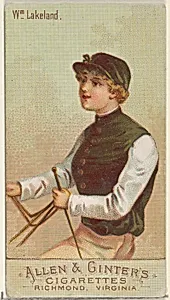
William Lakeland, from the Racing Colors of the World series (N22b) for Allen & Ginter Cigarettes
1888
Medium
Commercial color lithograph
Dimensions
Sheet: 2 3/4 x 1 1/2 in. (7 x 3.8 cm)
Classification
Prints|Ephemera
Department
Drawings and Prints
Museum
Metropolitan Museum of Art, New York, NY
Credit
The Jefferson R. Burdick Collection, Gift of Jefferson R. Burdick
Accession Number
63.350.201.22.68
Rights
Public Domain
Tags
Art Historical Context
Step into the vibrant world of 19th-century advertising with *William Lakeland* from Allen & Ginter's *Racing Colors of the World series (N22b), a delightful 1888 commercial color lithograph. Measuring just 2¾ x 1½ inches, this petite card was designed as a collectible insert in cigarette packs, showcasing the jockey's racing silks—those colorful patterns worn by riders to identify them during thrilling horse races. The tags highlighting women and jockeys suggest it captures the era's fascination with female participants in the sport, a rarity that adds intrigue to this ephemera. Allen & Ginter, pioneering tobacco magnates, revolutionized marketing with chromolithography, a technique that printed vivid, multi-layered colors affordably on a massive scale. Issued around 1888, these cards turned smokers into collectors, blending sport, fashion, and global flair by featuring racing colors from around the world. This example reflects the Gilded Age's obsession with horse racing as high society entertainment, while subtly nodding to trailblazing women jockeys amid a male-dominated field. Today, housed in the Metropolitan Museum of Art's Jefferson R. Burdick Collection—a landmark gift of over 30,000 ephemera—this tiny print preserves a snapshot of cultural history. It reminds us how everyday objects fueled passions for collecting and competition, bridging art, commerce, and sport in unexpected ways. (198 words)
About the Artist
Allen & Ginter
Allen & Ginter, the pioneering American tobacco firm based in Richmond, Virginia, emerged around 1880 from the partnership of John F. Allen and Lewis Ginter, evolving from Allen's earlier John F. Allen & Company. Allen retired in 1882, succeeded by John Pope, yet the brand endured under Ginter's leadership, employing over 1,100 workers—mostly women—for hand-rolled cigarettes by 1886. Ginter, a Dut...