
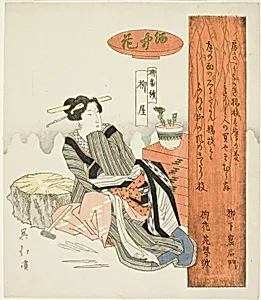
Willow Shop (Yanagiya), from the series "A Series of Willows (Yanagi bantsuzuki)"
c. 1828
Medium
Color woodblock print; shikishiban, surimono
Dimensions
21.1 × 18.2 cm (8 5/16 × 7 3/16 in.)
Classification
woodblock print
Department
Arts of Asia
Museum
Art Institute of Chicago
Accession Number
81023
Rights
Public Domain
Art Historical Context
**Willow Shop (Yanagiya), from *A Series of WillowsYanagi bantsuzuki*)** Created around 1828 by Totoya Hokkei, a prominent ukiyo-e artist pupil of the legendary Katsushika Hokusai, this charming woodblock print captures the poetry of Edo-period Japan. Hokkei, active in the late 18th and early 19th centuries, in intimate landscapes and genre scenes, often infusing them with delicate natural motifs like willows, which symbolized grace and resilience in Japanese culture. Part of a series celebrating willow imagery—evoking seasonal beauty and urban life—this piece likely depicts a quaint shop nestled among swaying branches, reflecting the bustling merchant culture of Tokyo (then Edo). Printed in the rare shikishiban format—a square shape ideal for private display—and as a *surimono*, this 21.1 × 18.2 cm color woodblock exemplifies luxury printing. *Surimono* were custom commissions for poetry societies or New Year's greetings, featuring embossed textures, metallic pigments, and vibrant hues achieved through precise carving and multiple color blocks. This technique elevated everyday subjects into art treasures, blending technical mastery with subtle elegance. Housed in the Art Institute of Chicago's Arts of Asia collection, *Willow Shop* offers a window into Japan's *ukiyo-e* golden age, where art democratized beauty for poetry lovers and collectors. Its compact intimacy invites close viewing, revealing Hokkei's skill in harmonizing human activity with nature's whisper.
About the Artist
Totoya Hokkei · 1780–1850
Totoya Hokkei (魚屋 北渓, 1780–1850), born Iwakubo Tatsuyuki in Edo (modern Tokyo), began his life as a humble fishmonger in the Yotsuya Samegahashi district, a trade reflected in his art name "Totoya," meaning fish shop. He transitioned to art through rigorous training, first studying under Kanō Yōsen'in Korenobu, head of the Kobikichō branch of the prestigious Kanō school, where he honed landscape p...