
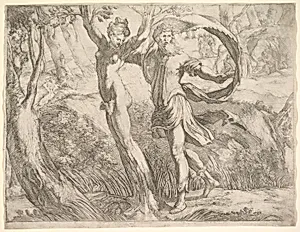
Wilton Album, folio 10a: Priapus and Lotis
Medium
Etching
Dimensions
Sheet: 7 7/8 x 10 3/4 in. (20 x 27.3 cm)
Classification
Prints
Department
Drawings and Prints
Museum
Metropolitan Museum of Art, New York, NY
Credit
Harris Brisbane Dick Fund, 1927
Accession Number
27.78.1(26)
Rights
Public Domain
Tags
Art Historical Context
Step into the enchanting world of Renaissance mythology with *Wilton Album, folio a: Priapus andis*, an etching from around 1530–50, now housed in the Metropolitan Museum of Art Drawings and Prints department. sheet, measuring 7 7/8 x 10 3/4 inches, draws from Ovid's *Metamorphoses depicting the woodland god Priapus in pursuit of the nymph Lotis, who transforms into tree to escape his advances. Attributed to Mannerist masters like Parmigianino (Girolamo Francesco Maria Mazzola), his uncle Girolamo Mazzola Bedoli, Jacopo Bertoia, or an anonymous Italian artist, it captures the era's fascination with classical tales of desire and transformation. Etching, a innovative 16th-century printmaking technique using acid to bite intricate lines into a metal plate, allowed for the fluid, elongated figures and dynamic compositions hallmark of Mannerism—a stylish evolution from High Renaissance ideals. The nude male and female forms, highlighted in the artwork's tags, evoke sensual tension, blending eroticism with narrative elegance typical of Italian workshops. Part of the renowned Wilton Album, a collector's compendium of prints acquired via the Harris Brisbane Dick Fund in 1927, this folio showcases the collaborative spirit of cinquecento artists. It invites visitors to ponder how such prints democratized elite art, spreading mythological motifs across Europe and influencing later Baroque drama.
About the Artist
Parmigianino (Girolamo Francesco Maria Mazzola)|Girolamo Mazzola Bedoli|Anonymous, Italian, 16th century|Bertoia (Jacopo Zanguidi) · 1503–1540
Girolamo Francesco Maria Mazzola, known as Parmigianino, was born on January 11, 1503, in Parma, into a family of artists. The eighth child of painter Filippo Mazzola and Donatella Abbati, he lost his father to the plague at age two and was raised by his uncles, Michele and Pier Ilario Mazzola, modestly talented painters who taught him the techniques of the craft. By his late teens, Parmigianino d...