
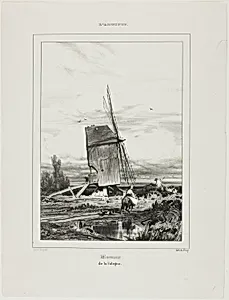
Windmill of Sologne
1835
Medium
Lithograph on paper
Dimensions
Image: 19.7 × 14 cm (7 13/16 × 5 9/16 in.); Sheet: 29.4 × 22.4 cm (11 5/8 × 8 7/8 in.)
Classification
lithograph
Department
Prints and Drawings
Museum
Art Institute of Chicago
Accession Number
43731
Rights
Public Domain
Art Historical Context
Jules Dupré’s “Windmill of Sologne,” created in 1835, captures a quiet rural scene from the marshy plains of central France. Dupré, who would become a leading member of the Barbizon school, was already exploring the unvarnished beauty of the French countryside at this early date. Rather than dramatic vistas, the lithograph presents a modest windmill silhouetted against an open sky, emphasizing atmosphere and the rhythms of everyday rural life. Printed as a lithograph on paper, the work benefited from a medium that was newly popular in the 1830s for its ability to convey soft tones and fine detail while allowing multiple impressions. At roughly 20 by 14 centimeters, the intimate scale encourages close looking, revealing Dupré’s sensitive handling of light and texture. Such prints helped bring images of regional France to urban audiences, fostering a growing appreciation for the nation’s varied landscapes. Today the sheet resides in the Art Institute of Chicago’s collection of prints and drawings, where it offers visitors a window onto both nineteenth-century printmaking techniques and the Barbizon commitment to painting from direct observation of nature.
About the Artist
Jules Dupré · 1811–1889
Jules Dupré (1811–1889) was born in Nantes, France, on April 5, the son of a porcelain manufacturer. He began his artistic career in his father's factory before moving to paint porcelain at his uncle's china factory in Sèvres. Lacking formal training or a specific teacher, Dupré debuted at the Paris Salon in 1831, earning a second-class medal three years later. A pivotal trip to England in 1834 ex...