
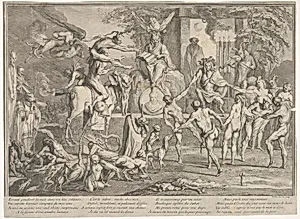
Witches' Sabbath, within a nocturnal landscape, a necromancer seated at top center wearing a robe and cap inscribed with Kabbalist symbols, below him to left a horse with the head of a beast, a ring of nude dancers to right, a robed with the head of a pig to left, various witches, sorcerers, strange animals, and monsters on the ground to left in the foreground, from 'The Sabbaths' (Les Sabbats)
ca. 1700–1720
Medium
Etching
Dimensions
image: 9 5/8 x 13 3/16 in. (24.4 x 33.5 cm)
Classification
Prints
Department
Drawings and Prints
Museum
Metropolitan Museum of Art, New York, NY
Credit
Bequest of Phyllis Massar, 2011
Accession Number
2012.136.375
Rights
Public Domain
Tags
Art Historical Context
Claude Gillot's *Witches' Sabbath*, etching from around 1700–1720 and part of the series * Sabbaths* (*Les Sabbats*), captures fantastical nocturnal gathering of the supernatural. At the top center, a robed necromancer with a cap inscribed with Kabbalist symbols presides over the chaotic scene. Below, a horse with a beast's head to the left, while a of nude dancers revels to the right. Foreground figures include a robed person with a pig's head, witches, sorcer, strange animals, monsters, and hints of musical instruments amid the frenzy. As an early 18th-century French artist, Gillot excelled in etching—a printmaking technique using acid to bite intricate lines into a metal plate, allowing for rich detail and multiple impressions. This medium was ideal for disseminating dramatic, imaginative subjects like witches' sabbaths, which drew from folklore and cultural fears of the occult persisting into the Enlightenment era. The work's blend of nudes, dancing, and monstrous hybrids reflects a playful yet eerie exploration of the macabre. Housed in the Metropolitan Museum of Art's Drawings and Prints department, this bequest from Phyllis Massar invites visitors to ponder the era's fascination with mysticism and the grotesque, blending horror with theatricality in a compact 9⅝ × 13¼-inch image.
About the Artist
Claude Gillot · 1673–1722
Artist known for his elegant designs done in the Rococo manner of Audran; also for his predilection for scenes from the 'comedia dell'arte.' Few paintings survive; his work is known mainly through drawings and etchings. Comment on works: Genre; History