
Woman Combing Her Hair (Femme qui se peigne)
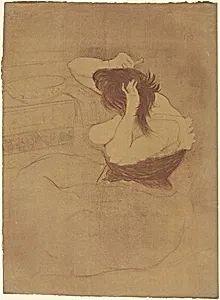
Medium
lithograph in violet and green-brown
Dimensions
image: 52 x 38.3 cm (20 1/2 x 15 1/16 in.) sheet: 52 x 38.3 cm (20 1/2 x 15 1/16 in.)
Classification
Department
CG-E
Museum
National Gallery of Art, Washington, D.C.
Credit
Rosenwald Collection
Accession Number
1947.7.153
Rights
Public Domain
Art Historical Context
Henri de Toulouse-Lautrec created this striking lithograph, *Woman Combing Her Hair*, in 1896 using violet and green-brown inks. Measuring about 20 by 15 inches, the print captures an intimate, everyday gesture with the artist's signature economy of line. As a leading Post-Impressionist, Lautrec excelled at depicting the vibrant yet often private worlds of late 19th-century Paris, blending keen observation with bold graphic simplicity. Lithography suited Lautrec perfectly, allowing fluid contours and layered colors that evoke both movement and quiet mood. The limited palette here heightens the scene's tenderness, reflecting his fascination with ordinary rituals of women in modern urban life. Influenced by Japanese prints, he distilled forms to their expressive essence, making even a simple act of combing hair feel immediate and human. This work, from the Rosenwald Collection at the National Gallery of Art, invites viewers to appreciate Lautrec's innovative printmaking, which helped define the visual energy of the Belle Époque. It remains a compelling window into his empathetic yet unsentimental view of daily existence.
About the Artist
Henri de Toulouse-Lautrec · 1864–1901
Henri Marie Raymond de Toulouse-Lautrec-Montfa (1864-1901) was a French Post-Impressionist painter, printmaker, and illustrator whose innovative poster designs revolutionized graphic art and advertising in late 19th-century Paris. Born into an aristocratic family at Albi in southern France, Toulouse-Lautrec's privileged lineage traced back to the Counts of Toulouse and extended uninterrupted to th...