
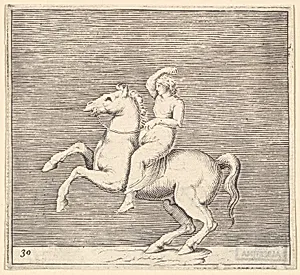
Woman on Rearing Horse, from "Ex Antiquis Cameorum et Gemmae Delineata/ Liber Secundus/et ab Enea Vico Parmen Incis"
Medium
Engraving; third state
Dimensions
plate: 3 7/16 x 4 7/8 in. (8.8 x 12.4 cm)
Classification
Prints
Department
Drawings and Prints
Museum
Metropolitan Museum of Art, New York, NY
Credit
The Elisha Whittelsey Collection, The Elisha Whittelsey Fund, 1949
Accession Number
49.97.430
Rights
Public Domain
Tags
Art Historical Context
Behold *Woman on Rearing Horse*, a captivating engraving from the Renaissance-era publication *Ex Antiquis Came et Gemmae Deline, Liber Secundus*, incised by the master engraver Enea Vico of Parma. This third-state impression, published around 1599–1622, faithfully reproduces an ancient cameo or gemstone carving, showcasing a dynamic female figure mastering a rearing stallion. The scene evokes classical motifs of heroism and equestrian prowess, likely drawing from Greco-Roman artifacts that fascinated 16th-century collectors. Enea Vico, alongside influences from Francesco Angeloni, Battista Franco, Philippe Thomassin, and anonymous Italian artists, spearheaded efforts to document and disseminate antiquity's treasures. In an age of fervent humanism, such prints bridged ancient art with contemporary audiences, fueling the Renaissance revival of classical forms. Engraving's precision—achieved through intricate copperplate incisions—allowed for detailed textures, from the horse's taut muscles to the woman's flowing drapery, making high art accessible beyond elite gem collectors. Housed in the Metropolitan Museum of Art's Drawings and Prints department (The Elisha Whittelsey Collection, 1949), this 3 7/16 x 4 7/8-inch plate exemplifies printmaking's role in preserving cultural heritage. It invites us to ponder the timeless allure of women and horses as symbols of power and grace across millennia.
About the Artist
Francesco Angeloni|Battista Franco|Philippe Thomassin|Enea Vico|Anonymous, Italian, 16th century (Italian|Italian|French|Italian|Italian) · 1559 |1510 |1562 |1523 |1500 –1652 |1561 |1622 |1567 |1600
Terni 1559 or 1587–1652 Rome|Italian, Venice ca. 1510–1561 Venice|French, Troyes 1562–1622 Rome|Italian, Parma 1523–1567 Ferrara|