
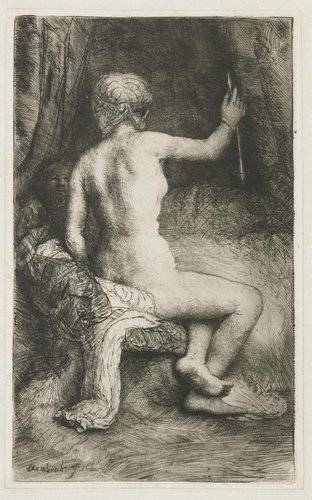
Woman with the arrow
Medium
etching
Dimensions
204; 123
Rights
Public Domain
About this artwork
verzamelaarsmerk, verso linksonder, gestempeld: Lugt 240
Art Historical Context
**Woman with the Arrow**, a captivating etching by Rembrandt van Rijn from 1661, showcases the master's late-career brilliance during the Dutch Golden Age. Measuring just 204 mm high by 123 mm wide, this intimate work exemplifies Rembrandt's profound skill in printmaking. As a pioneer of etching, he used a needle to incise lines into a copper plate coated in acid-resistant ground, allowing the acid to bite intricate details and create rich tonal contrasts that mimic his famed oil paintings' luminosity and depth. Created when Rembrandt was in his mid-50s, amid personal and financial struggles, the artwork reflects his mature Baroque style—marked by emotional intensity and masterful light effects. The enigmatic "woman with the arrow" evokes themes of love, fate, or Cupid's influence, common in 17th-century Dutch art blending portraiture with symbolism. Rembrandt produced fewer but more experimental etchings in this period, pushing the medium's limits for velvety textures and dramatic shadows. A collector's mark (Lugt 240) stamped verso lower left underscores its esteemed provenance, linking it to prestigious European collections. This small gem invites close contemplation, revealing Rembrandt's genius in transforming metal and ink into profound human expression.
About the Artist
Rembrandt van Rijn · 1606–1669
Rembrandt Harmenszoon van Rijn (1606–1669) stands as one of the greatest visual artists in the history of Western art and the most important Dutch painter of the 17th century. Born in Leiden to a prosperous miller's family, Rembrandt transformed painting through his revolutionary use of light and shadow, his psychological depth in portraiture, and his elevation of etching to a fine art. His approx...