
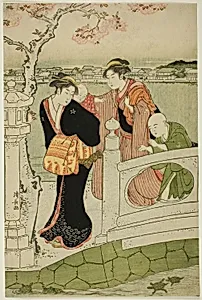
Women and Children on the Causeway at Shinobazu Pond
c. 1788
Medium
Color woodblock print; right sheet of oban triptych
Dimensions
38 × 24.9 cm (15 × 9 13/16 in.)
Classification
woodblock print
Department
Arts of Asia
Museum
Art Institute of Chicago
Accession Number
22726
Rights
Public Domain
Art Historical Context
Torii Kiyonaga's *Women and Children on the Causeway at Shinobazu* (c. 1788) captures a serene moment of everyday leisure in Edo-period Japan. This vibrant color woodblock print depicts elegant women and playful children strolling along the causeway of Shinobazu Pond in U, a beloved Tokyo spot known for its lotus blooms and boating pleasures. As the right sheet of an ob triptych—a large-format, three-panel composition—it invites viewers to imagine the full panoramic scene unfolding across the set. Kiyonaga, a leading ukiyo-e ("pictures of the floating world") master from the Torii school, excelled in bijin-ga, or images of beautiful women, with his signature elongated figures and graceful poses. Printed using the intricate nishiki-e technique—employing multiple woodblocks for rich, brocade-like colors—this work exemplifies late 18th-century innovations in Japanese printmaking, achieving depth through subtle gradations and delicate lines. Housed in the Art Institute of Chicago's Arts of Asia collection, this print reflects the cultural vibrancy of urban Edo life, where art democratized depictions of fashion, nature, and social harmony for a wide audience. Measuring 38 × 24.9 cm, it offers a window into a fleeting, joyful world.
About the Artist
Torii Kiyonaga · 1752–1815
Torii Kiyonaga, born Sekiguchi Shinsuke in 1752 in Uraga, Sagami Province, was the son of an Edo bookseller who owned tenements near a bustling fish market. At age 14 in 1765, he began his apprenticeship under Torii Kiyomitsu, the third-generation head of the prestigious Torii school of ukiyo-e, renowned for kabuki theater illustrations and signage. Adopted into the Torii family, Kiyonaga succeede...