
Wood Warbler, from the Birds of America series (N37) for Allen & Ginter Cigarettes
1888
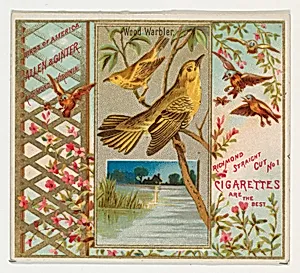
Medium
Commercial color lithograph
Dimensions
Sheet: 2 7/8 x 3 1/4 in. (7.3 x 8.3 cm)
Classification
Prints|Ephemera
Department
Drawings and Prints
Museum
Metropolitan Museum of Art, New York, NY
Credit
The Jefferson R. Burdick Collection, Gift of Jefferson R. Burdick
Accession Number
63.350.202.37.48
Rights
Public Domain
Tags
Art Historical Context
Behold the delicate *Wood Warbler* from *Birds of America series (N37), a charming chromolithograph produced by the pioneering tobacco firm Allen & G in 1888. This tiny gem, measuring just 2 7/8 x 3 1/4 inches, was one of 50 cards inserted into cigarette packages, transforming everyday smoking into a gateway for collecting and learning about North American birds. Allen & Ginter, innovators in marketing, popularized these trade cards in the Gilded Age, blending commerce with education and sparking a nationwide hobby. Crafted as a commercial color lithograph, the card showcases the era's breakthrough in printing technology. Chromolithography enabled vivid, multi-layered colors—up to 30 stones per image—reproducing the warbler's subtle plumage and lively pose with stunning realism on a small scale. Housed in the Metropolitan Museum of Art's Jefferson R. Burdick Collection, it exemplifies ephemera: humble objects that captured public imagination. These cards democratized ornithological knowledge, inspired by John James Audubon's grand *Birds of America* but made accessible to all. Today, they remind us how 19th-century advertising fueled curiosity about the natural world, turning a wood warbler's fleeting song into enduring art. (198 words)
About the Artist
Allen & Ginter
Allen & Ginter, the pioneering American tobacco firm based in Richmond, Virginia, emerged around 1880 from the partnership of John F. Allen and Lewis Ginter, evolving from Allen's earlier John F. Allen & Company. Allen retired in 1882, succeeded by John Pope, yet the brand endured under Ginter's leadership, employing over 1,100 workers—mostly women—for hand-rolled cigarettes by 1886. Ginter, a Dut...