
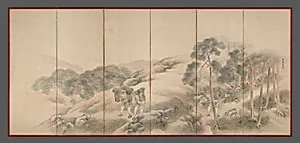
松村呉春筆 山樵漁夫図屏風|Woodcutters and Fishermen
ca. 1790–95
Medium
Pair of six-panel folding screens; ink and color on paper
Dimensions
Image (each): 65 15/16 in. × 12 ft. 2 7/16 in. (167.5 × 372 cm) Overall with mounting: 67 1/2 in. × 12 ft. 4 in. (171.5 × 376 cm)
Classification
Paintings
Culture & Period
Japan · Edo period (1615–1868)
Department
Asian Art
Museum
Metropolitan Museum of Art, New York, NY
Credit
Mary Griggs Burke Collection, Gift of the Mary and Jackson Burke Foundation, 2015
Accession Number
2015.300.206.1, .2
Rights
Public Domain
Tags
About this artwork
This pair of six-panel folding screens depicts woodcutters trudging among pines and fishermen relaxing on a small boat, set against rolling hills and an enclosed lagoon during early spring. Chinese fishermen and woodcutters, their faces weathered and animated, move through a hazy landscape where linear perspective indicative of Maruyama Ōkyo's influence melds with the lyricism absorbed from Yosa Buson. Matsumura Goshun, born to a family of officials at the government mint, studied with literati ...
Art Historical Context
In the tranquil haze of early spring, Matsumura Goshun's *Woodcutters and Fishermen*ca. 1790–95) unfolds across a pair of magnificent six-panel folding screens, a hallmark of Edo-period (1615–1868) Japanese art. Weathered Chinese-inspired figures—woodcutters trud among towering pines and fishermen lounging in a small boat—animate a poetic landscape of rolling hills and an enclosed lagoon. Rendered in delicate ink and color on paper these screens measure an imposing 67½ × 148 inches overall, designed to immerse viewers in nature's quiet drama. Goshun, born into a family of government mint officials, first apprenticed under literati master Yosa Buson, absorbing his lyrical touch, before joining Kyoto's innovative circle around Maruyama Ōkyo in 1787. Ōkyo's school blended traditional Japanese techniques with Western-style linear perspective and realism, which Goshun masterfully fuses here. This synthesis elevates humble rural motifs—drawn from Chinese painting traditions—into a uniquely Japanese vision, capturing animated faces and atmospheric depth. Housed in the Metropolitan Museum of Art's Mary Griggs Burke Collection, these screens exemplify the Edo era's artistic ferment, where literati elegance met bold innovation, inviting us to ponder the harmony between labor and landscape.
About the Artist
Matsumura Goshun · 1752–1811
Born in Kyoto, 1752, the eldest son of a prominent family. He studied calligraphy, music, and painting from an early age. His painting studies were under Ōnishi Suigetsu.