
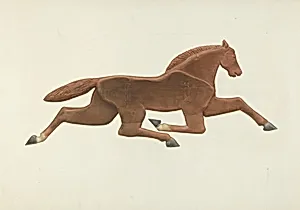
Wooden Horse Weather Vane
c. 1940
Medium
watercolor and graphite on paper
Dimensions
overall: 29.9 x 42.5 cm (11 3/4 x 16 3/4 in.) Original IAD Object: 61" long
Classification
Index of American Design
Department
CG-W
Museum
National Gallery of Art, Washington, D.C.
Credit
Index of American Design
Accession Number
1943.8.16245
Rights
Public Domain
Art Historical Context
Behold the *Wooden Horse Weather V*, a captivating watercolor and graphite rendering by Alfred H. Smith, created around 1940. Measuring 29.9 x 42.5 cm, this artwork faithfully captures the spirited form of a traditional American folk object—a 61-inch-long weather vane depicting a dynamic horse in mid-gallop. Smith's precise graphite outlines and vibrant watercolors bring the sculptural details to life, from the flowing mane to the whimsical proportions typical of vernacular craftsmanship. This piece is part of the *Index of American Design*, a monumental WPA Federal Art Project from the 1930s and early 1940s that employed artists to document everyday American folk art through detailed renderings. Amid the Great Depression, the initiative preserved vanishing cultural treasures, highlighting objects like weather vanes that dotted New England barns and steeples. These functional sculptures, often hand-carved by local artisans, symbolized Yankee ingenuity and pointed the way with the wind—both literally and as emblems of rural American life. Smith's technique exemplifies the Index's goal: accurate yet artistic reproduction on paper, blending technical draftsmanship with subtle color washes to evoke texture and patina. Housed in the National Gallery of Art, it invites us to appreciate how such humble designs reflect a nation's creative spirit.
About the Artist
Alfred H. Smith · 1855–present
Alfred H. Smith was an American artist active from around 1935 to 1953, best known for his meticulous watercolor and graphite drawings documenting American folk and decorative arts. Little is known about his early life or formal training, as biographical details remain sparsely documented beyond his contributions to federal art initiatives. During the Great Depression, Smith participated in the In...