
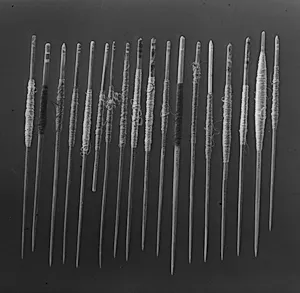
Wooden Spindle
Unknown Artist
10th–16th century (?)
Medium
Wood, camelid hair
Dimensions
Overall: 8 1/2 x 1/4 in. (21.59 x 0.64 cm) Other: 1/4 in. (0.64 cm)
Classification
Textiles-Implements
Culture
Peruvian
Department
Arts of Africa, Oceania, and the Americas
Museum
Metropolitan Museum of Art, New York, NY
Credit
Gift of George D. Pratt, 1933
Accession Number
33.149.164
Rights
Public Domain
Art Historical Context
This delicate wooden spindle, hailing from ancient Peru and dating to the 10th–16th century, offers a glimpse into the everyday ingenuity of pre-Columbian societies. Crafted from with camelid hair—likely from alpacas or llamas, animals central to Peruvian life—the tool measures a slender 8½ inches long and just a quarter-inch thick. As a textiles implement, it was used for spinning fine yarns, a process vital to one of the world's most sophisticated textile traditions. In Peruvian culture, textiles were far more than fabric; they served as currency, ritual garments, and symbols of status, often rivaling gold in prestige. Women, in particular, were master spinners, using drop spindles like this to create intricate patterns woven into cloth for clothing, blankets, and ceremonial items. The combination of lightweight wood for the shaft and fibrous camelid hair for the whorl allowed for precise control, producing threads renowned for their strength and vibrancy. Today, this spindle resides in the Metropolitan Museum of Art's Department of Arts of Africa, Oceania, and the Americas, a gift from George D. Pratt in 1933. Though humble in scale, it embodies the enduring craftsmanship of Peru's ancient peoples, reminding us how simple tools fueled a rich artistic legacy.