
Wooden Spindle
Unknown Artist
10th–16th century (?)
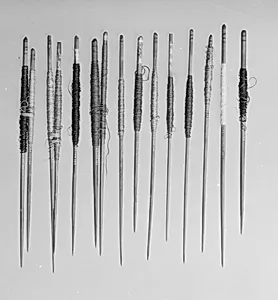
Medium
Wood, camelid hair
Dimensions
Overall: 7 3/4 x 1/4 in. (19.69 x 0.64 cm) Other: 1/4 in. (0.64 cm)
Classification
Textiles-Implements
Culture
Peruvian
Department
Arts of Africa, Oceania, and the Americas
Museum
Metropolitan Museum of Art, New York, NY
Credit
Gift of George D. Pratt, 1933
Accession Number
33.149.177
Rights
Public Domain
Art Historical Context
This delicate wooden spindle, hailing from ancient Peru and dating to the 10th–16th century, offers a glimpse into the daily ingenuity of pre-Columbian societies. Measuring just 7 3/4 inches long and slender at a quarter-inch in diameter, it was crafted from wood and adorned or weighted with camelid hair— from alpacas or llamas, animals central to Peruvian life for fiber, transport, and sustenance. As a humble yet essential tool classified among textiles implements, it belonged to the vibrant world of the Inca Empire or earlier cultures like the Chimú or Wari, where textiles were not mere cloth but symbols of status, trade, and ritual. Spindles like this were used to twist fibers into yarn, a process dominated by women whose skilled weaving produced some of the finest textiles in the ancient world—vibrant fabrics woven with geometric patterns and mythical motifs. The combination of wood for the shaft and camelid hair for the whorl (the spinning weight) highlights practical artistry: lightweight for portability, yet balanced for efficiency. These tools were so revered they often accompanied the dead in burials, underscoring spinning's role in cosmology and community. Today, this spindle graces the Metropolitan Museum of Art's Arts of Africa, Oceania, and the Americas collection, a gift from George D. Pratt in 1933. It reminds us how everyday objects encode cultural stories, bridging the tactile craft of Peru's past with our modern appreciation for indigenous innovation.