
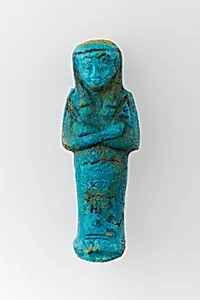
Worker Shabti of Henettawy (C), Daughter of Isetemkheb
Unknown Artist
ca. 990–970 B.C.
Medium
Faience
Dimensions
H. 12 x W. 4.5 x D. 3.6 cm (4 3/4 x 1 3/4 x 1 7/16 in.)
Classification
Shabti, Henettawy C
Period
Third Intermediate Period
Department
Egyptian Art
Museum
Metropolitan Museum of Art, New York, NY
Credit
Rogers Fund, 1925
Accession Number
25.3.19.46
Rights
Public Domain
Art Historical Context
This delicate faience shabti, standing just under 5 inches tall, served as a "worker" figurine for Henettawy (C), a high-ranking noblewoman and daughter of Isetemheb during Egypt's Third Intermediate Period (asty 21, ca. 990–970 B.C.). In ancient Egyptian belief, shabtis like this one were magically activated in the afterlife to perform laborious tasks—such as farming or building—for their owner, allowing the deceased noble to enjoy eternal leisure. Crafted with a vibrant blue-green glaze typical of faience, a composite material of crushed quartz and frit fired with a glossy surface, it evokes the Nile's fertile waters and themes of rebirth. Produced during a time of political fragmentation, when high priests of Amun held sway in Thebes amid weakened pharaonic rule, this shabti reflects the era's enduring funerary traditions. Faience was prized for its affordability and luminous color, making such afterlife servants accessible to elites beyond royal tombs. Henettawy's figure, with its mummiform body, crossed arms holding tools, and hieroglyphic spells on the legs, exemplifies the standardized yet finely detailed workmanship of the period. Today, acquired through the Rogers Fund in 1925, this artifact at the Metropolitan Museum of Art offers a poignant glimpse into ancient Egyptian hopes for immortality, blending artistry with profound spiritual purpose.