
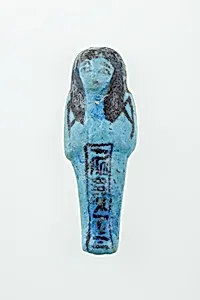
Worker Shabti of Nauny
Unknown Artist
ca. 1050 B.C.
Medium
Faience
Dimensions
H. 8.9 × W. 3 × D. 2.2 cm (3 1/2 × 1 3/16 × 7/8 in.)
Classification
Shabti, worker, Nauny
Period
Third Intermediate Period
Department
Egyptian Art
Museum
Metropolitan Museum of Art, New York, NY
Credit
Rogers Fund, 1930
Accession Number
30.3.30.20
Rights
Public Domain
Art Historical Context
This petite faience shabti, or "worker" figurine, served as a devoted servant for Nauny, a high-ranking noblewoman from ancient Egypt's Third Intermediate PeriodDynasty 21, ca. 1050 B.C.). Standing just 8.9 cm tall, it was one of many such figures buried in her tomb near Thebes, designed to perform laborious tasks in the afterlife so the deceased could enjoy eternal rest. Crafted during a time of political fragmentation, when priestly families held sway in southern Egypt, these ushabtis reflected a democratizing trend in funerary practices—once elite privileges now more widely adopted. Made of vibrant blue-green faience—a glazed, molded ceramic prized for its jewel-like sheen symbolizing rebirth and the Nile's fertility—the shabti exemplifies efficient mass production techniques. Artisans shaped it from frit (a quartz-based paste), fired it, and applied a copper-based glaze for enduring color. Inscribed with spells from the Book of the Dead, it was "activated" to answer its owner's call with the words, "Here I am!" Today, acquired through the Rogers Fund in 1930, this artifact at the Metropolitan Museum of Art offers a glimpse into ancient Egyptian beliefs in immortality and the afterlife's daily labors.