
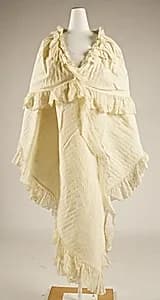
Wrap
Unknown Artist
late 18th century
Medium
linen
Classification
Wrap
Culture
French
Department
Costume Institute
Museum
Metropolitan Museum of Art, New York, NY
Credit
Purchase, Irene Lewisohn Bequest, 1970
Accession Number
1970.281.2
Rights
Public Domain
Art Historical Context
This delicate linen *Wrap* from late 18th-century France offers a glimpse into the everyday elegance of pre-Revolutionary fashion. Housed in the Metropolitan Museum of Art's Costume Institute, it the period's shift from opulent Rococo excess toward simpler, more neoclassical silhouettes inspired by ancient Greece and Rome. As a lightweight garment—likely a shawl or cloak—such wraps were essential for women navigating the bustling streets of Paris or Versailles gardens, providing both modesty and mobility. Crafted from fine linen, a breathable natural fiber prized for its durability and comfort in warmer months, the wrap highlights the technical prowess of French textile artisans. Linen's subtle weave allowed for intricate pleating or draping, techniques that echoed classical statuary and influenced designers like Marie Antoinette's own modistes. Though the artist remains unknown, this piece embodies the anonymous mastery of France's couture workshops, where functionality met subtle sophistication. Acquired through the Irene Lewisohn Bequest in 1970, the *Wrap* stands as a testament to the Met's commitment to preserving fashion history. It invites us to imagine the lives of its wearers amid the eve of revolution, reminding visitors that even humble fabrics tell stories of cultural transformation.