
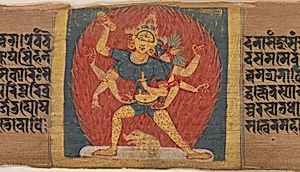
Wrathful Eight-armed and Three-faced Goddess Tara Marichi, Leaf from a dispersed Pancavimsatisahasrika Prajnaparamita Manuscript
Unknown Artist
ca. 1090
Medium
Opaque watercolor on palm leaf
Dimensions
2 1/4 x 22 1/2 in. (5.7 x 57.2 cm)
Classification
Paintings
Culture & Period
India (Bengal) or Bangladesh · Pala period
Department
Asian Art
Museum
Metropolitan Museum of Art, New York, NY
Credit
Rogers Fund, 1955
Accession Number
55.121.36.9
Rights
Public Domain
Tags
Art Historical Context
This exquisite leaf from a dispersed *Pancavimsatisahasrikarajnaparamita*, dating to around 1090, showcases the wrathful eight-armed and three-faced Goddess Tara Marichi in vibrant opaque watercolor on palm leaf. just 2¼ x 22½ inches, this fragile page from the Bengal region of India (or possibly Bangladesh) exemplifies the Pala period's mastery of miniature painting. The elongated palm leaf format, traditional for sacred texts in ancient South Asia, allowed scribes and artists to illustrate Buddhist sutras with intricate iconography, including dynamic deities and symbolic animals. The *Pancavimsatisahasrika Prajnaparamita* ("Perfection of Wisdom in Twenty-Five Thousand Lines") is a cornerstone Mahayana Buddhist text emphasizing transcendent wisdom. Tara Marichi, a fierce protective form of the goddess Tara, embodies enlightenment's power to dispel obstacles, her multiple arms wielding ritual implements and her three faces conveying compassion, wrath, and pacification. Produced during the Pala dynasty's golden age of Buddhist patronage (8th–12th centuries), such illuminated manuscripts were revered in monasteries, blending text and image to aid meditation. The opaque watercolor technique—layered mineral pigments for jewel-like intensity—highlights the Pala school's refined style, influencing later Tibetan and Nepalese art. Though the artist remains unknown, this leaf's survival speaks to the enduring cultural reverence for Buddhist deities in medieval Bengal. (198 words)