
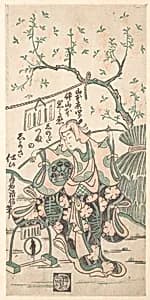
Yamamoto Iwanojō, Son of Yamamoto Kyōshirō, as Shinoda Zuma in a Shosa Act
Medium
Woodblock print; ink and color on paper
Dimensions
11 1/2 x 5 9/16 in. (29.2 x 14.1 cm)
Classification
Prints
Culture & Period
Japan · Edo period (1615–1868)
Department
Asian Art
Museum
Metropolitan Museum of Art, New York, NY
Credit
The Howard Mansfield Collection, Purchase, Rogers Fund, 1936
Accession Number
JP2625
Rights
Public Domain
Tags
Art Historical Context
Step into the vibrant world of Edo-period Japan with this exquisite woodblock print by Tor Kiyonobu II, created in 1747. Titled *Yamamoto Iwanoj, Son of Yamamoto Kyshirō, as Shin Zuma in a Shosa Act*, it captures the celebrated Kabuki actor in the female role of Shinoda Zuma during a dramatic *shosa* (lion dance) scene. Kiyonobu, a master of the Torii school specialized in *yakusha-e*—actor portraits that immortalized theater stars, blending realism with stylized flair to convey emotion and movement. During Japan's Edo period (1615–1868), ukiyo-e prints like this one celebrated the "floating world" of entertainment, where Kabuki thrived as popular culture. Actor prints were affordable souvenirs for fans, showcasing *onnagata* (male actors playing women) like Iwanojō, whose expressive pose amid trees and figures highlights the theatricality of the era. The intimate dimensions (11 1/2 x 5 9/16 in.) made it perfect for personal collections. Crafted with ink and color on paper through meticulous woodblock carving—where artisans layered colors via separate blocks—this print exemplifies Torii's bold lines and vivid hues. Now in the Metropolitan Museum of Art's Asian Art collection (from The Howard Mansfield Collection, 1936), it offers a window into 18th-century Japan's cultural pulse, where art and performance danced as one.
About the Artist
Torii Kiyonobu II · 1702–1752
Japanese, ca. 1702–1752