
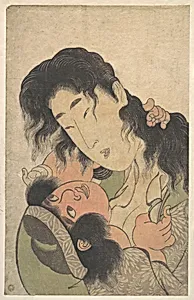
喜多川歌麿画 山姥と金太郎|Yamauba Playing with Kintarō
ca. 1795
Medium
Woodblock print (nishiki-e); ink and color on paper
Dimensions
H. 14 1/4 in. (36.2 cm); W. 9 in. (22.9 cm)
Classification
Prints
Culture & Period
Japan · Edo period (1615–1868)
Department
Asian Art
Museum
Metropolitan Museum of Art, New York, NY
Credit
Gift of Estate of Samuel Isham, 1914
Accession Number
JP981
Rights
Public Domain
Tags
Art Historical Context
In this vibrant woodblock print from around 1795, Kitagawa Utamaro captures a tender moment from Japanese folklore: the mountain hag Yamauba playfully wrestling with the superhuman boy Kintarō, a legendary child who would grow into the warrior Sakata Kintoki. Utamaro, a master of ukiyo-e ("pictures of the floating world"), is celebrated for his exquisite depictions of women, and here he infuses the mythical hag with surprising warmth and humanity, her robust form contrasting delightfully with Kintarō's chubby strength. Created during Japan's Edo period (1615–1868), this nishiki-e—or "brocade picture"—showcases the pinnacle of woodblock printing artistry. Multiple carved woodblocks were meticulously inked with vivid colors and layered onto paper, achieving a luxurious, almost textured depth in the figures' kimonos and dynamic poses. Measuring about 14 by 9 inches, it's a classic ōban format, designed for affordable display in urban homes amid the era's booming print culture. Kintarō's tale, rooted in kabuki theater and popular tales, symbolized youthful vigor and nature's wild power, making this print a cultural touchstone. Donated to the Metropolitan Museum of Art in 1914, it invites visitors to appreciate Utamaro's genius in blending myth, playfulness, and exquisite craft.
About the Artist
Kitagawa Utamaro · 1753–1806
Kitagawa Utamaro (c. 1753-1806) was one of the most celebrated masters of ukiyo-e woodblock printing, revolutionizing the art of bijin-ga (pictures of beautiful women) during Japan's Edo period. Born Kitagawa Ichitaro, his early life remains shrouded in mystery, with conflicting accounts placing his birth in Kyoto, Osaka, Yoshiwara in Edo (modern Tokyo), or Kawagoe in Musashi Province. Under the t...