
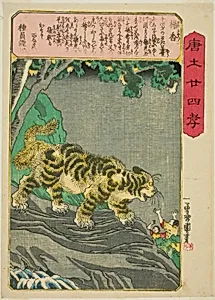
Yang Xiang (Yo Kyo), from the series "Twenty-four Paragons of Filial Piety in China (Morokoshi nijushiko)"
c. 1848/50
Medium
Color woodblock print; chuban
Dimensions
25.1 × 18.1 cm (9 7/8 × 7 1/8 in.)
Classification
woodblock print
Department
Arts of Asia
Museum
Art Institute of Chicago
Accession Number
149895
Rights
Public Domain
Art Historical Context
This vibrant woodblock print by Utagawa Kuniy, a master of the ukiyo-e tradition, depicts *Yang Xiang (Yo K)* from the series *Twenty-four Paragons of Filial Piety in China (Morokoshi nijushiko)*, created around 1848–50. Kuniyoshi, renowned for his dynamic warrior prints and imaginative compositions, here turns his skill to moral tales drawn from ancient Chinese Confucian lore. These "paragons" were immensely popular in Edo-period Japan (1603–1868), serving as educational tools to instill virtues like filial piety—deep respect for one's parents—in everyday viewers through affordable art. Printed in the chuban format (a compact 25.1 × 18.1 cm), this color woodblock exemplifies nishiki-e, or "brocade pictures," where intricate carving and multiple color blocks produced rich, layered hues. Kuniyoshi's bold lines and expressive figures bring the legendary devotion of Yang Xiang to life, capturing the emotional intensity of these stories amid Japan's vibrant print culture. Housed in the Art Institute of Chicago's Arts of Asia department, it reflects how ukiyo-e bridged entertainment and ethics, making profound cultural ideals accessible to all.
About the Artist
Utagawa Kuniyoshi · 1797–1861
Utagawa Kuniyoshi (1797–1861) was born in Edo to the silk-dyer Yanagiya Kichiyemon, originally bearing the childhood name Yoshisaburō. From a young age, he assisted in his family's pattern design work, which sharpened his innate mastery of color and textile motifs that would permeate his later prints. At around twelve years old, his prodigious drawing skills drew the attention of the renowned Utag...