
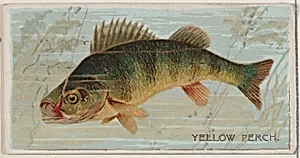
Yellow Perch, from the series Fishers and Fish (N74) for Duke brand cigarettes
Medium
Commercial color lithograph
Dimensions
Sheet: 1 7/16 × 2 3/4 in. (3.6 × 7 cm)
Classification
Prints|Ephemera
Department
Drawings and Prints
Museum
Metropolitan Museum of Art, New York, NY
Credit
The Jefferson R. Burdick Collection, Gift of Jefferson R. Burdick
Accession Number
63.350.204.74.25
Rights
Public Domain
Tags
Art Historical Context
Step into the vibrant world of 19th advertising with *Yellow Perch*, charming chromolithograph from the *Fishers and Fish (N74)* series issued by W. Duke, & Co. in 1888. Produced as a promotional insert for Duke brand cigarettes and printed by Knapp & Company this tiny gem measures just 1 7/16 × 2 3/4 inches, perfectly sized to tuck into cigarette packs. It captures the striking yellow hues and sleek form of the yellow perch, a freshwater fish native to North America, rendered with lively detail to entice collectors. Chromolithography, the medium here, was a breakthrough in commercial printing, allowing mass production of colorful images that mimicked fine art at low cost. Tobacco companies like Duke pioneered these trade cards in the 1880s, turning everyday purchases into a collecting craze—buy more packs, complete the set! This series highlighted fish and anglers, blending education on natural history with clever marketing. Today, housed in the Metropolitan Museum of Art's Jefferson R. Burdick Collection, *Yellow Perch* exemplifies ephemeral art's enduring appeal. It reflects Gilded Age consumerism, where bold visuals hooked consumers, and reminds us how everyday objects like cigarette cards became cultural treasures preserved for posterity.
About the Artist
W. Duke, Sons & Co.|Knapp & Company · 1870–1920
**W. Duke, Sons & Co.: Pioneers of Chromolithographic Trade Card Art** W. Duke, Sons & Co., an American tobacco manufacturer, emerged from the entrepreneurial vision of Washington Duke (1820–1905) and his sons in Durham, North Carolina. After the Civil War, Washington abandoned farming in 1874 to join his eldest son, Brodie L. Duke, in the burgeoning tobacco trade, establishing a factory that for...