
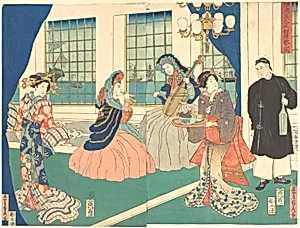
Yokohama Foreigners in the Sitting Room of a Merchant Ship
1861, 9th month
Medium
Middle panel of a triptych of woodblock prints; ink and color on paper
Dimensions
O-ban triptych with JP3179
Classification
Prints
Culture & Period
Japan · Edo period (1615–1868)
Department
Asian Art
Museum
Metropolitan Museum of Art, New York, NY
Credit
Gift of Lincoln Kirstein, 1959
Accession Number
JP3180
Rights
Public Domain
Art Historical Context
Created in 1861 during Japan’s late Edo period, this middle panel of a triptych captures a rare glimpse of cultural exchange following the opening of Yokohama to foreign trade. Utagawa (Gountei) Sadahide, active in the ukiyo-e tradition, depicts Western merchants in the sitting room of a foreign vessel, reflecting the curiosity and fascination that accompanied the end of Japan’s long isolation. The scene records the arrival of new peoples, fashions, and technologies at a pivotal moment before the Meiji Restoration. Executed as a woodblock print in ink and color on paper, the work belongs to the Yokohama-e genre that flourished after 1859. These affordable prints allowed a broad Japanese audience to encounter images of outsiders and their surroundings, blending traditional print techniques with fresh subject matter. The triptych format enabled Sadahide to present an expansive interior view while maintaining the lively detail and vibrant palette characteristic of ukiyo-e. Today housed in the Metropolitan Museum of Art, the print offers modern viewers insight into Japan’s first sustained contact with the West and the artistic response it inspired.
About the Artist
Utagawa (Gountei) Sadahide · 1807–1873
Utagawa Sadahide was born Hashimoto Kenjirō in 1807 in Fusa Province, in the area of modern Chiba Prefecture, Japan. In the 1820s he entered the studio of the enormously prolific and influential master Utagawa Kunisada, becoming one of Kunisada's most prominent pupils and adopting the studio name Sadahide along with the Utagawa school's celebrated lineage. By 1828 his name appeared on a monument l...