
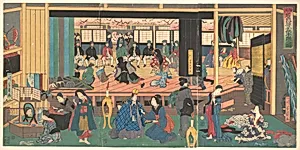
Yokohama Gankirō kodomo te odori no zu|Foreigners Enjoying Children's Kabuki at the Gankirō Tea House
1st month, 1861
Medium
Triptych of woodblock prints; ink and color on paper
Dimensions
Image (a): 14 3/8 x 9 7/8 in. (36.5 x 25.1 cm) Image (b): 14 3/8 x 9 7/8 in. (36.5 x 25.1 cm) Image (c): 14 3/8 x 9 7/8 in. (36.5 x 25.1 cm)
Classification
Prints
Culture & Period
Japan · Edo period (1615–1868)
Department
Asian Art
Museum
Metropolitan Museum of Art, New York, NY
Credit
Bequest of William S. Lieberman, 2005
Accession Number
2007.49.160a–c
Rights
Public Domain
Tags
Art Historical Context
In the vibrant world of late Edo-period Japan, Utagawa Yoshikazu's *Foreigners Enjoying Children's Kabuki at the Gankirō Tea House* (1861) captures a rare moment of cultural exchange. This triptych woodblock print depicts Western visitors—likely sailors or traders from newly opened treaty ports like Yokohama—delightfully immersed in a performance of *kodomo te odori*, or children's Kabuki dance, at the famed Gankirō teahouse. Amidst lanterns, mirrors reflecting the lively scene, and flickering candlelight, men and women revel in the theatrical spectacle, highlighting the "floating world" (*ukiyo-e*) fascination with entertainment and novelty. Produced just seven years before the Edo period's end in 1868, the print reflects Japan's turbulent opening to the West after Commodore Perry's 1854 arrival. Yokohama, a bustling port, became a hub for foreigners, sparking both curiosity and tension. Yoshikazu, from the prolific Utagawa school, mastered *Yokohama-e*—prints portraying these exotic encounters—using vivid ink and color on paper to convey dynamic compositions across three sheets, each about 14 x 10 inches. The medium's brilliance lies in its collaborative woodblock process, layering colors for rich depth and intricate details like flowing kimonos and expressive faces. This Met Museum treasure invites us to ponder early globalization's joys, preserved through William S. Lieberman's bequest.
About the Artist
Utagawa Yoshikazu · 1845–1870
Utagawa Yoshikazu (active circa 1850–1870) was a Japanese ukiyo-e woodblock print artist who came of age during one of the most dynamic periods in Japanese history — the twilight of the Edo period and the dawning of the Meiji era. Born and active in Edo (present-day Tokyo), he trained under the celebrated master Utagawa Kuniyoshi, one of the towering figures of the Utagawa school renowned for his ...