
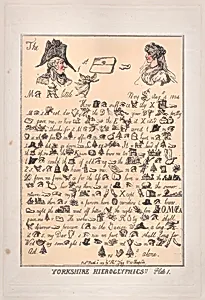
Yorkshire Hieroglyphics, Plate 1
Medium
Hand-colored etching
Dimensions
Plate: 13 3/4 × 9 3/4 in. (35 × 24.7 cm) Sheet (trimmed): 15 7/16 × 10 7/16 in. (39.2 × 26.5 cm)
Classification
Prints
Department
Drawings and Prints
Museum
Metropolitan Museum of Art, New York, NY
Credit
The Elisha Whittelsey Collection, The Elisha Whittelsey Fund, 1959
Accession Number
59.533.1996
Rights
Public Domain
Tags
Art Historical Context
**Yorkshire Hieroglyphics Plate 1** (1809) is a vibrant hand-colored etching by the renowned British caricaturist Thomas Rowland, published by Thomas T. Measuring about 14 10 inches, this print draws on the ancient of hieroglyphs to a explosive political scandal. Created amid early 19th-century Britain's print culture, it exemplifies Rowlandson's mastery of exaggerated, witty caricature, a staple of Georgian satire that made complex events accessible and entertaining to the public. The artwork lampoons Prince Frederick, Duke of York—brother to King George IV and Commander-in-Chief of the Army—and his mistress Mary Anne Clarke, whose 1809 corruption trial rocked Parliament. Clarke was accused of selling military commissions for profit, forcing the Duke's resignation. Rowlandson ingeniously reimagines their intrigue as cryptic "hieroglyphics," blending humor with sharp political critique in a style tied to the Romantic era's printmaking revolution. As part of the Metropolitan Museum of Art's Elisha Whittelsey Collection, this piece highlights etching's role in disseminating satire. Hand-coloring added lively appeal, making it a collector's item and a window into how art fueled public discourse on power and scandal. Visitors will appreciate its clever fusion of history, humor, and visual flair.
About the Artist
Prince Frederick Augustus, Duke of York and Albany|Mary Anne Clarke|Thomas Tegg|Thomas Rowlandson (British|British|British) · 1763 |1757 |1776 –1827 |1827 |1846
British, London 1763–1827 London|British, London 1757–1827 London|British, London 1776–1846 London