
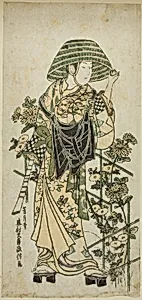
Young Man Dressed as Mendicant Monk
c. 1755
Medium
Color woodblock print; hosoban, benizuri-e
Dimensions
30.5 × 14.3 cm (12 × 5 1/2 in.)
Classification
woodblock print
Department
Arts of Asia
Museum
Art Institute of Chicago
Accession Number
8951
Rights
Public Domain
Art Historical Context
In the vibrant world of 18th-century Edo (modern-day Tokyo), Okumura Masanobu's *Young Man Dressed as Mendicant Monk* (c. 1755) captures the playful spirit of ukiyo-e, the "pictures of the floating world" that celebrated urban life, theater, and fashion. This color woodblock print, measuring a slender 30.5 × 14.3 cm in the hosoban format—a narrow, vertical half-sheet popular for affordable single-sheet prints—depicts a stylish young man in the humble robes of a mendicant monk, blending high fashion with theatrical role-playing. Masanobu, a pioneering printmaker active from the 1710s to 1760s, helped advance color printing techniques with benizuri-e, or "rose-colored pictures." Using just two woodblocks—one for black outlines and details, another for pinkish-red tones—this method created vivid yet economical contrasts, bridging single-color urushi-e and full-color nishiki-e that would dominate later. Produced during Japan's Genroku era of prosperity, such prints were ubiquitous in teahouses and merchant homes, reflecting kabuki influences where actors donned beggar disguises for dramatic flair. Housed in the Art Institute of Chicago's Arts of Asia department, this work highlights ukiyo-e's cultural role in democratizing art, making sophisticated visuals accessible to everyday people and foreshadowing masters like Hiroshige and Hokusai.
About the Artist
Okumura Masanobu · 1686–1764
Japanese, 1686–1764