
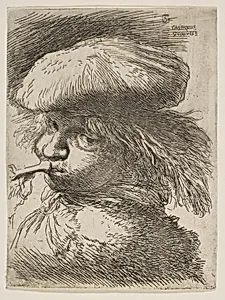
Young man with a trumpet facing left, from "Small Heads in Oriental Headdress"
Medium
Etching
Dimensions
Sheet: 4 1/4 × 3 1/8 in. (10.8 × 8 cm)
Classification
Prints
Department
Drawings and Prints
Museum
Metropolitan Museum of Art, New York, NY
Credit
Purchase, Joseph Pulitzer Bequest, 1917
Accession Number
17.50.17-76
Rights
Public Domain
Tags
Art Historical Context
In the intimate etching *Young Man with a Trumpet Facing Left*, from Giovanni Benedetto Castiglione's (Il Grechetto) seriesSmall Heads in Oriental He* (ca. 1645–50), a youthful figure gazes sideways, his lips pursed around a gleaming trumpet while adorned in an elaborate turban. This diminutive work, measuring just 4¼ × 3⅛ inches, captures the Baroque artist's fascination with exotic costumes, reflecting 17th-century Europe's growing curiosity about the Orient amid expanding trade routes and diplomatic exchanges. Castiglione, a Genoese master (1609–1664), was a pioneer among Italian artists in etching, rivaling Rembrandt in technical virtuosity. He employed fine, fluid lines and subtle tonal effects through hatching and drypoint to evoke texture—from the trumpet's metallic sheen to the turban's intricate folds—bringing dramatic light and shadow to these small-scale portraits. His innovative monotype experiments further highlight his role in elevating printmaking as fine art. Housed in the Metropolitan Museum of Art's Drawings and Prints department, this piece exemplifies how Castiglione blended portraiture with fantasy, turning everyday musicians into enigmatic Eastern archetypes. A delightful gem for print enthusiasts, it invites visitors to ponder the era's blend of realism and romantic exoticism.
About the Artist
Giovanni Benedetto Castiglione (Il Grechetto) · 1609–1664
Giovanni Benedetto Castiglione, known as Il Grechetto, was baptized on March 23, 1609, in Genoa and died on May 5, 1664, in Mantua. Born into a large family, he collaborated closely with his brother Salvatore, an artist who shared his talents, and later taught his son Francesco, whose works were sometimes confused with his own. His parents placed him in the studio of Giovanni Battista Paggi, where...