
融齋畫譜|Yūsai Picture Album (Yūsai gafu 融齋畫譜)
preface date: 1831 (Tenpō 2)
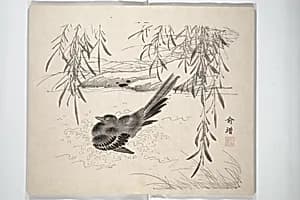
Medium
Woodblock printed book (orihon, accordion-style); ink and color on paper
Dimensions
10 15/16 × 6 5/16 in. (27.8 × 16 cm)
Classification
Illustrated Books
Culture & Period
Japan · Edo period (1615–1868)
Department
Asian Art
Museum
Metropolitan Museum of Art, New York, NY
Credit
Purchase, Mary and James G. Wallach Foundation Gift, 2013
Accession Number
2013.667
Rights
Public Domain
Tags
Art Historical Context
Step into the refined world of Edo-period Japan with *Yūsai Picture AlbumYūsai gafu 融齋畫譜)* by Nakabayashi Chikutō (6–1853), a woodblock-printed book prefaced in 1831 (Tenpō 2). This accordion-style orihon format—measuring 10 15/16 × 5/16 inches—unfolds like a fan to reveal a series of vibrant ink and color illustrations on paper, primarily featuring birds. As a master of literati painting, Chikut drew inspiration from Chinese traditions, blending delicate brushwork with Japanese sensibility in this intimate album. During the Edo period (1615–1868), woodblock printing revolutionized art dissemination, making high-quality designs accessible beyond elite circles. Gafu like this served as both artistic portfolios and instructional manuals for aspiring painters, capturing the era's fascination with nature's fleeting beauty. Chikutō's birds, rendered with poetic precision, evoke the bunjin (literati) spirit—emphasizing personal expression over rigid convention—and highlight the cultural reverence for avian motifs as symbols of harmony and transience. Acquired through the Mary and James G. Wallach Foundation Gift in 2013, this treasure from the Metropolitan Museum of Art's Asian Art collection invites visitors to unfold its pages and immerse in Japan's artistic legacy, where every feather tells a story of elegance and impermanence.
About the Artist
Nakabayashi Chikutō 中林竹洞 (Japanese) · 1776 –1853
Japanese, 1776–1853