
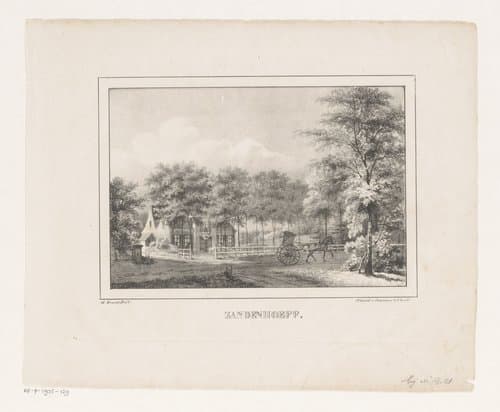
Zandenhoeff
1829
Medium
lithography
Dimensions
292; 240
Rights
Public Domain
About this artwork
lithografie
Art Historical Context
**Zandenhoeff** is a delicate lithograph created by Michel Mourot in1829, measuring a modest 240 mm high by 292 mm wide. This print captures the early enthusiasm for lithography, a revolutionary technique invented just three decades earlier by Alois Senefelder. traditional engraving, lithography allowed artists to draw directly a smooth limestone surface with greasy crayons or ink, blending the freedom of drawing with the precision of printmaking. The resulting images retained the artist's personal touch, making it ideal for reproducing landscapes, architecture, and everyday scenes affordably across Europe. Mourot's work exemplifies lithography's rise in the 1820s and 1830s, a period when it transformed visual culture by democratizing art. No longer confined to elite workshops, prints like this could reach wider audiences through books, portfolios, and posters. The title *Zandenhoeff*—likely referencing a Dutch estate or sandy homestead ("zand" meaning sand and "hoef" suggesting a farmstead)—hints at a picturesque or topographical subject, common in this era's fascination with regional heritage amid industrialization. Though details on Mourot remain sparse, *Zandenhoeff* stands as a testament to lithography's artistic and technical innovations, bridging Romantic-era sensibilities with emerging mass media. Visitors, imagine holding this intimate sheet, a window into 19th-century Europe's evolving print world!