
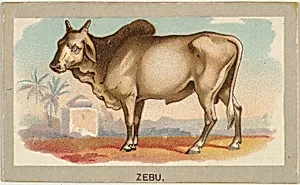
Zebu, from the Animals of the World series (T180), issued by Abdul Cigarettes
1881
Medium
Commercial color lithograph
Dimensions
Sheet: 1 5/8 × 2 3/4 in. (4.2 × 7 cm)
Classification
Prints|Ephemera
Department
Drawings and Prints
Museum
Metropolitan Museum of Art, New York, NY
Credit
The Jefferson R. Burdick Collection, Gift of Jefferson R. Burdick
Accession Number
63.350.246.180.30
Rights
Public Domain
Tags
Art Historical Context
This charming small print depicts a zebu, a humped cattle native to Asia and Africa, as part of the “Animals of the World” series issued by Abdul Cigarettes in 1881. Produced as commercial color lithograph measuring 1 5/8 by 2 3/4 inches, the card was designed to be tucked into cigarette packages, turning an everyday purchase into an opportunity for collecting and learning. Color lithography allowed manufacturers to create bright, affordable images that reached a wide audience during the late nineteenth century. Such trade cards blended advertising with popular education, introducing exotic animals to smokers who might never visit a zoo or natural-history museum. The series encouraged repeated purchases while subtly promoting global awareness through appealing, pocket-sized illustrations. Now part of the Metropolitan Museum’s Jefferson R. Burdick Collection, this ephemera offers a glimpse into Victorian-era marketing and the early history of mass-produced color imagery. Its modest format belies its role in shaping how people encountered the natural world through everyday consumer goods.
About the Artist
Abdul Cigarettes · 1881–1881
Abdul Cigarettes, an enigmatic American entity active solely in 1881, stands as a fascinating footnote in the history of commercial art, best known for producing vibrant chromolithograph trade cards inserted into cigarette packages as promotional inserts. Little is documented about its origins or personnel, suggesting it operated as a short-lived publishing venture rather than the work of a singul...