
Zeekreeft
1560 - 1585
Medium
brush
Dimensions
305; 247; 208; 125
Rights
Public Domain
About this artwork
hoogte 125 mm (opgezet) x breedte 247 mm (opgezet) x hoogte 208 mm x breedte 305 mm
Art Historical Context
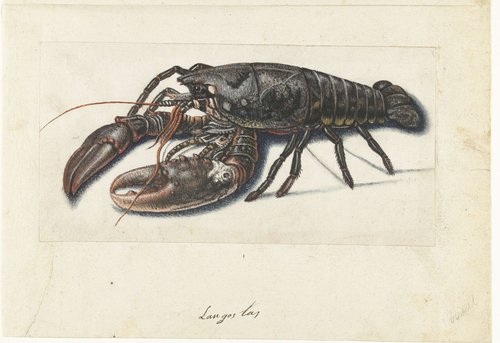
**Zeekreeft (Lobster)** *Anonymous, 1560–1585* *Brush on paper, 125 × 247 mm* Step into the curious world of16th-century Northern European natural history with *Zeekreeft*, a delicate brush painting depicting a lobster. Created anonymously between 1560 and 1585, this small-scale work (roughly 5 × 10 inches) captures the crustacean's intricate form with remarkable precision. The Dutch title, meaning "sea lobster," hints at its origins in the Low Countries, artists during the Renaissance began meticulously documenting marine life for scholarly collections and early scientific studies. Rendered in brush technique—likely watercolor or gouache on paper—this artwork exemplifies the era's emerging tradition of natura morta (still life) and nature studies. The modest dimensions suggest it was part of a larger album or cabinet of curiosities, popular among collectors like apothecaries and natural philosophers. Such pieces bridged art and science, offering lifelike references before photography, with the mounted support (208 × 305 mm) indicating careful preservation for display. Though anonymous, *Zeekreeft* reflects the cultural fascination with exotic sea creatures in a time of expanding trade and exploration. It invites us to marvel at the anonymous artist's skill in rendering textures—from the lobster's spiny shell to its segmented claws—reminding visitors of art's role in preserving the wonders of the natural world.
About the Artist
anonymous
In the vast tapestry of art history, "Anonymous" stands not as a singular individual but as a collective designation for countless unidentified creators whose works have endured across millennia. These artists, spanning prehistoric cave painters to medieval illuminators and folk craftsmen, produced the foundational layers of human visual culture. Prior to the Renaissance, when individual fame emer...