
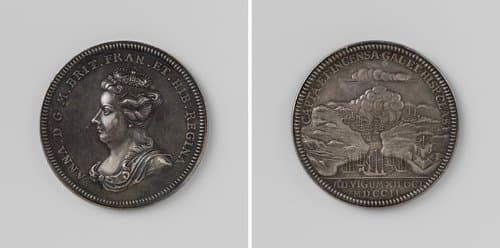
Zeeslag bij Vigo (Vigos): het verbranden van de Franse en Spaanse vloot
Medium
striking (metalworking)
Dimensions
30.96; 4.1
Rights
Public Domain
About this artwork
diameter 4.1 cm x weight 30.96 gr
Art Historical Context
Behold the intricate *Zeeslag bij Vigo (igos): het verbrand van de Franse en Sp vloot* (Sea Battle at Vigo Bay: The Burning of the French and Spanish Fleet a struck medal crafted by German engraver and medalist Christianermuth in 1702. Measuring just 4.1 cm in diameter and weighing 30.96 grams, diminutive bronze treasure commemorates a pivotal naval clash during the War of the Spanish Succession. October 12, 1702, an Anglo-Dutch fleet decisively defeated the Franco-Spanish armada in Vigo Bay, Spain, capturing vast treasure galleons and torching enemy ships to prevent recapture—a triumph that boosted Allied morale and weakened Bourbon naval power. Wermuth, renowned for his dynamic battle scenes in miniature, employed the striking technique: hammering a die into softened metal to create high-relief designs with remarkable detail. This method allowed for mass production of portable propaganda pieces, ideal for circulation among Europe's elites and military circles. The medal's obverse likely captures the chaotic inferno of burning galleons, evoking the era's fervor for naval glory. As a historical artifact, this medal encapsulates early 18th-century medallic art's role in glorifying warfare and diplomacy. Its pocket-sized scale made it a wearable emblem of victory, bridging artistry and propaganda in an age of grand fleets and fragile alliances. A true gem for collectors of militaria!
About the Artist
Christian Wermuth · 1661–1739
Christian Wermuth (1661–1739) was a prolific and highly influential German medallist, coin engraver, bookseller, and publisher whose work epitomized the Baroque tradition of medallic art in the German territories. Born on December 16, 1661, in Altenburg and dying on December 3, 1739, in Gotha, Wermuth's career spanned nearly eight decades of intense artistic production, pedagogical influence, and ...