
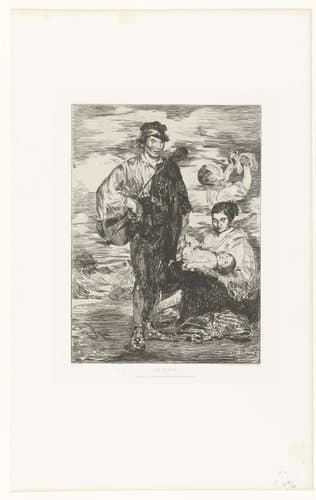
Zigeunerfamilie met man en vrouw met kind
1862
Medium
etching
Dimensions
330; 238; 528; 318
Rights
Public Domain
About this artwork
Lithografie gepubliceerd in de eerste uitgave van Société des Aquafortistes, Delâtre (drukker), Parijs 1 september 1862
Art Historical Context
Edouard Manet's *Zigeunerfamilie man en vrouw met kind (Gypsy Family with Man, Woman, and Child), created in 1862, is a striking etching measuring 318 mm high by 238 mm wide. This intimate print captures a Romani family in a candid, everyday moment, reflecting Manet's early fascination with marginalized communities and urban life. As a pioneer of modern art on the cusp of Impressionism Manet used the etching medium to explore bold compositions and loose, expressive lines, departing from academic precision. Published in the inaugural edition of the *Société des Aquafortistes* on September 1, 1862, in Paris by printer Auguste Delâtre, the work holds historical significance as part of a short-lived but influential etching society co-founded by Manet. This group aimed to revive etching—a direct, painterly intaglio technique where acid bites into a metal plate—as a fine art accessible to collectors, countering the dominance of lithography and painting. Manet's etching showcases his virtuoso control of line and tone, evoking texture and movement with minimal strokes. Though small in scale, this piece exemplifies Manet's innovative spirit, blending realism with emerging modernity. It invites visitors to appreciate how 19th-century printmaking bridged old techniques and new visions of society.
About the Artist
Edouard Manet · 1832–1883
Édouard Manet (1832-1883) was a French painter who played a pivotal role in the transition from Realism to Impressionism, often called the 'Father of Modern Art.' Born into a wealthy Parisian family, Manet defied his father's wishes for a legal career to pursue painting, studying under academic artist Thomas Couture. His revolutionary works 'Le Déjeuner sur l'herbe' and 'Olympia' (both 1863) scand...