
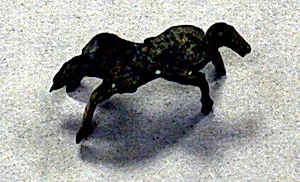
Zoomorphic Figure
Unknown Artist
12th–16th century
Medium
Copper alloy
Dimensions
H. 1/2 × L. 1 in. (1.3 × 2.5 cm)
Classification
Metal-Sculpture
Culture
Middle Niger civilization
Department
Arts of Africa, Oceania, and the Americas
Museum
Metropolitan Museum of Art, New York, NY
Credit
Bequest of John B. Elliott, 1997
Accession Number
1999.47.92
Rights
Public Domain
Tags
Art Historical Context
This petite Zoomorphic Figure, crafted from copper alloy by an unknown artist of the Middle Niger civilization, dates to the 12th–16th centuries. Measuring just 1/2 inch high and 1 inch long, this delicate metal sculpture captures an animal form—likely symbolic of wildlife central to the region's cosmology—in a style typical of West African bronze casting traditions. Housed in the Metropolitan Museum of Art's Department of Arts of Africa, Oceania, and the Americas, it entered the collection through the 1997 bequest of John B. Elliott. Originating from the Inland Niger Delta in present-day Mali, the Middle Niger civilization thrived along fertile riverbanks, fostering advanced urban centers like Jenne-Jeno and innovative metallurgy. Such small-scale figures, often lost-wax cast, served as amulets, ritual objects, or adornments, embodying spiritual connections between humans, animals, and the divine. The mastery of copper alloy—smelted locally and worked with precision—highlights the culture's technical prowess during a era of trade and cultural exchange across the Sahel. Today, this tiny treasure offers a window into pre-colonial African artistry, reminding us how miniature forms could hold immense cultural power. Visitors are invited to ponder: what stories might this enigmatic creature tell of ancient Niger River life?