
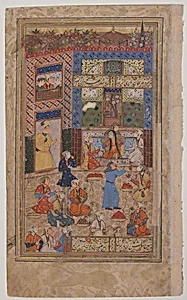
"Zulaikha after her Second Dream of Yusuf", Folio from a Yusuf and Zulaikha of Jami
second half 16th century
Medium
Opaque watercolor and gold on paper
Dimensions
H. 9 in. (22.9 cm) W. 5 1/4 in. (13.3 cm)
Classification
Codices
Department
Islamic Art
Museum
Metropolitan Museum of Art, New York, NY
Credit
Cora Timken Burnett Collection of Persian Miniatures and Other Persian Art Objects, Bequest of Cora Timken Burnett, 1956
Accession Number
57.51.39.76
Rights
Public Domain
Tags
Art Historical Context
This exquisite folio, "Zulaikha after her Second Dream of Yusuf," captures a poignant moment from the beloved Persian romance by the 15th-century poet Jami. The scene illustrates Zulaikha, deeply moved after dreaming of the handsome Yusuf, whose story echoes the biblical tale of Joseph and Potiphar’s wife. Created in the second half of the 16th century, this work belongs to a lavishly illustrated manuscript that brought poetic tales of love, longing, and spiritual devotion to life for royal and elite audiences. As a fine example of Persian miniature painting from the Islamic Art collection at The Metropolitan Museum of Art, the piece reflects the rich tradition of manuscript illumination during the Safavid era. Such codices served not only as literary treasures but also as vehicles for moral and mystical teachings, blending romance with Sufi symbolism. The intimate scale—measuring just 9 by 5¼ inches—invited close, personal viewing, often within private libraries or courtly settings. Executed in opaque watercolor and gold on paper, the painting showcases the refined techniques of Persian artists: delicate brushwork, vibrant pigments, and shimmering gold highlights that convey both earthly beauty and otherworldly grace. The tags noting men and women hint at the narrative’s focus on human connection, making this folio a captivating window into 16th-century Persian culture and storytelling.