
Zwaardstootplaat
1800 - 1900
Medium
iron (metal)
Dimensions
9; 1.5; 8.7
Rights
Public Domain
About this artwork
On loan from the Royal Asian Art Society in The Netherlands (Westendorp-Osieck bequest, 1968)
Art Historical Context
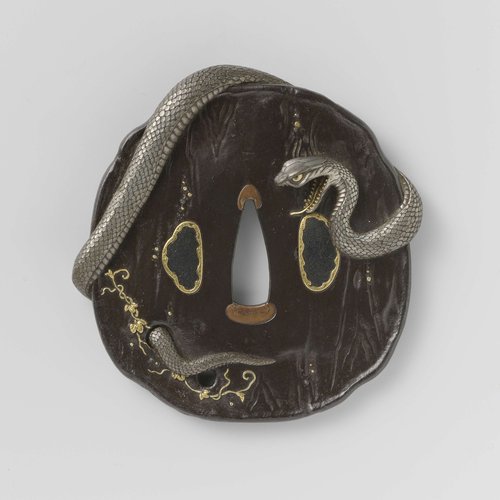
Behold the intricate *Zwaardstootplaat* (Dutch for "sword thrust plate"), a masterful iron tsuba—orguard—crafted by Japanese artisan Munemasa Shinoda between 1800 and1900. Measuring a compact 9 cm high, 8.7 cm wide, and 1.5 cm deep, this delicate yet robust piece was designed to protect the wielder's hand on a samurai sword, exemplifying the fusion of utility and artistry in Edo- and early Meiji-period Japan. Forged from iron, a favored medium for tsuba due to its durability and workability, Shinoda's creation highlights the technical prowess of Japanese metalworkers. These guards often featured perforated designs, inlays, or subtle patinas that evoked nature, mythology, or warrior ideals, transforming a functional component into a wearable sculpture. Though specific motifs here remain unnoted, its modest scale underscores the precision required in sword fittings, essential to the samurai class's ceremonial and martial culture. Generously on loan from the Royal Asian Art Society in The Netherlands via the Westendorp-Osieck bequest of 1968, this tsuba bridges Eastern craftsmanship with European appreciation, inviting us to ponder the global allure of Japan's enduring sword arts.