
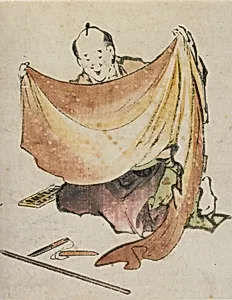
A Cloth Merchant
1760-1849
Classification
Painting
Department
Smithsonian Collection
Museum
Smithsonian American Art Museum
Credit
Gift of Charles Lang Freer
Accession Number
F1904.215
Rights
Public Domain
Tags
About this artwork
To 1904
Art Historical Context
Katsushika Hokus (1760–1849), one of Japan's most celebrated artists, captures the vibrant everyday life of Edo-period Japan (1615–1868) in *A Cloth Merchant*. This depicts a humble yet dignified man, likely a textile seller from the bustling merchant class that thrived during this era of relative peace and prosperity under the Tokugawaogunate. Hokusai, renowned for his ukiyo-e woodblock like *The Great Wave off Kawa*, often turned his keen eye to ordinary people, infusing their portraits with subtle character and cultural nuance. Though the medium remains unidentified, the work exemplifies Hokusai's mastery in portraying human figures with expressive simplicity, reflecting the Edo period's fascination with urban scenes and commerce. It entered the Smithsonian American Art Museum as a gift from Charles Lang Freer, the pioneering collector of Asian art whose Freer Gallery of Art enriched American appreciation for Japanese masterpieces. By 1904, it was part of Freer's esteemed collection, bridging East and West. This piece invites visitors to glimpse the industrious heart of historic Japan, where merchants like this cloth seller symbolized economic vitality and social mobility. A testament to Hokusai's enduring legacy, it reminds us of art's power to preserve fleeting moments of daily life.