
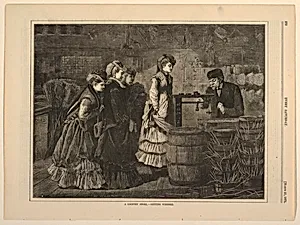
A Country Store – Getting Weighed
March 25, 1871
Medium
figures
Classification
figures
Department
Smithsonian Collection
Museum
Smithsonian American Art Museum
Credit
Gift of John Goldsmith Phillips, Jr.
Accession Number
1947-4-34
Rights
Public Domain
About this artwork
Research in Progress
Art Historical Context
Winslow Homer, a pioneering American Realist painter and illustrator (1836–1910), captured the rhythms of everyday rural life in *A Country Store – Gettingighed*, dated March 25, 1871. This work, likely a detailed wood engraving or drawing from his prolific period contributing to periodicals like Harper's Weekly, a quintessentially American scene: locals gathered at a modest country store, with one figure stepping onto a scale amid the camaraderie of neighbors. The title evokes ahearted moment of community interaction, highlighting Homer's keen eye for ordinary folk and their unpretentious world. Created in the post-Civil War era, the artwork reflects a nostalgic view of small-town America during a time of rapid industrialization and urbanization. Homer, who began his career as a freelance illustrator, mastered techniques like precise line work and tonal shading in prints, bringing authenticity and vitality to his "figures"—the classification here emphasizing the human subjects as central to the composition. His Realistic style rejected romantic idealization, instead celebrating the dignity and humor in working-class life. Today, this piece graces the Smithsonian American Art Museum, a gift from John Goldsmith Phillips, Jr., underscoring Homer's enduring influence on American genre art. Though research continues, it invites us to ponder the simple rituals that bound communities together. (198 words)