
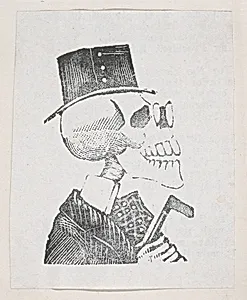
A profile of a skeleton with a tophat, a coat, and glasses, from a broaside entitled 'La Calavera de Cupido', published by Antonio Vanegas Arroyo.
ca. 1880–1910
Medium
Type-metal engraving (reproduction?)
Dimensions
Sheet: 2 13/16 × 2 3/8 in. (7.2 × 6 cm)
Classification
Prints
Department
Drawings and Prints
Museum
Metropolitan Museum of Art, New York, NY
Credit
Gift of Jean Charlot, 1930
Accession Number
30.82.44
Rights
Public Domain
Tags
Art Historical Context
José Guadalupe Posada, a pioneering Mexican printmaker active from the late 19th to 20th century, this witty *A Profile of a Skeleton with aophat, a Coat, and Glasses* as part of the broadside *La Calavera deido* (The Skull of Cupid), published by Antonio Vanegas Arroyo around 1880–1910. Drawn from Mexico's vibrant tradition of satirical street literature, the tiny type-metal engraving—measuring just 2 13/16 × 2 3/8 inches—depicts a dapper skeleton embodying Cupid, complete with spectacles, top hat, and coat. This macabre figure pokes fun at love's fleeting nature and societal pretensions, a hallmark of Posada's iconic *calaveras* (skeletons) that blurred the lines between humor, mortality, and social critique. Posada's work, produced in cheap, accessible broadsides sold by street vendors, captured the spirit of Porfirian Mexico and the brewing Revolution, influencing later artists like Diego Rivera. His bold, high-contrast relief prints, often using foundry type-metal, democratized art for the masses, foreshadowing modern graphic design and Día de los Muertos imagery. Today, this piece from the Metropolitan Museum of Art's Drawings and Prints collection—gifted by Jean Charlot in 1930—reminds us that even Cupid dances with death, inviting us to laugh in its face.
About the Artist
José Guadalupe Posada · 1852–1913
José Guadalupe Posada (1852-1913) was a Mexican printmaker and engraver who revolutionized popular art and created some of the most iconic images in Mexican culture. Working primarily with publisher Antonio Vanegas Arroyo, he produced over 20,000 images during his career—inexpensive broadsheets sold for a penny on colored paper that made his art accessible to even the poorest workers. He transform...