
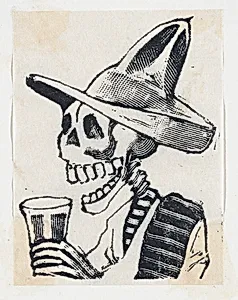
A skeleton wearing a hat having a drink (vignette for the feast of the dead)
ca. 1890–1910
Medium
Type-metal engraving
Dimensions
Sheet: 2 9/16 × 1 15/16 in. (6.5 × 5 cm)
Classification
Prints
Department
Drawings and Prints
Museum
Metropolitan Museum of Art, New York, NY
Credit
Gift of Jean Charlot, 1930
Accession Number
30.82.4
Rights
Public Domain
Tags
Art Historical Context
José Guadalupe Posada, a pioneering Mexican printmaker active in the late 19th and early 20th, created this whimsical vignette titled *A Skeleton Wearing a Hat Having a (Vignette for the Feast the Dead)* around 1890–1910. Posada was renowned for his *calaveras*—satirical skeletons that poked fun at social hierarchies, politicians, and everyday life, blending Mexican folk traditions with biting commentary. This tiny engraving (just 2 9/16 × 1 15/16 inches) captures a skeleton casually sipping a drink while sporting a jaunty hat, evoking the irreverent spirit of Mexico's *Día de Muertos* precursors like All Souls' Day feasts, where death is celebrated rather than feared. Crafted in type-metal engraving—a relief printing technique Posada innovated by repurposing metal from printing presses—this work was designed for mass-produced broadsheets (*calaveritas literarias*). The modest medium allowed for affordable, widespread distribution in newspapers and pamphlets, democratizing art during Mexico's Porfiriato era. Its stark black lines and exaggerated features highlight Posada's bold, graphic style, influencing later artists like Diego Rivera and modern Day of the Dead iconography. Today, housed in the Metropolitan Museum of Art's Drawings and Prints department (gift of Jean Charlot, 1930), this vignette reminds us of death's equalizing humor: even skeletons raise a glass to life's absurdities. A perfect emblem of Posada's enduring legacy in Mexican popular culture.
About the Artist
José Guadalupe Posada · 1852–1913
José Guadalupe Posada (1852-1913) was a Mexican printmaker and engraver who revolutionized popular art and created some of the most iconic images in Mexican culture. Working primarily with publisher Antonio Vanegas Arroyo, he produced over 20,000 images during his career—inexpensive broadsheets sold for a penny on colored paper that made his art accessible to even the poorest workers. He transform...