
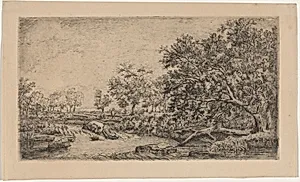
A t Pontchéry, Isère (A Pontcheruy , Isère, vue d’une chute d’eau)
Medium
etching and drypoint on tan laid paper
Dimensions
plate: 15.8 × 28.7 cm (6 1/4 × 11 5/16 in.) sheet: 19.8 × 32.1 cm (7 13/16 × 12 5/8 in.)
Classification
Department
CG-E
Museum
National Gallery of Art, Washington, D.C.
Credit
Gift of James A. Bergquist, Boston, in honor of Shelley R.Langdale
Accession Number
2020.149.7
Rights
Public Domain
Art Historical Context
In the mid-19th century, artist Louis Hector François Allemand captured the dramatic beauty of the French Alps in *A Pontchéry, Isère (A Pontcheruy, Is, vue d’une chute’eau)*, an 1857 and drypoint on tan laid paper. This intimate print depicts a cascading waterfall at Pontuy in the Isère, showcasing Allemand's affinity for rugged natural landscapes. As a of fine printmaking, he often the mountainous terrains of southeastern France,oking the Romantic era's for nature's sublime power during a time when industrialization was transforming rural scenes. Allemand's mastery shines in his combined use of etching—where acid etches lines into a metal plate for precise detail—and drypoint, a direct scratching technique that produces soft, velvety burrs for texture and depth. These methods lend the 15.8 × 28.7 cm plate a tactile richness, ideal for conveying the mist-shrouded rocks and rushing water. Printed on warm tan laid paper, the work highlights subtle tonal variations, making it a standout example of 19th-century landscape printmaking. Today, this piece resides in the National Gallery of Art's collection, gifted by James A. Bergquist in honor of Shelley R. Langdale. It invites visitors to appreciate how prints democratized access to grand vistas, bridging fine art with everyday wonder. (198 words)