
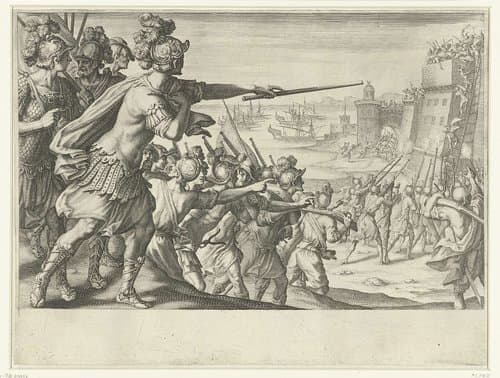
Aanval van de troepen van Ferdinando I de' Medici op de stad Preveza in Albanië
1614 - 1620
Medium
engraving
Dimensions
297; 224
Rights
Public Domain
About this artwork
blad: hoogte 224 mm x breedte 297 mm
Art Historical Context
Jacques Callot's *Aanval van de troepen Ferdinando I de' op de stad Preve in Albanië* (Attack of the Troops of Ferd I de' Medici on City of Preveza Albania), created between 1614 and1620, captures a dramatic moment of military ambition. This engraving, measuring 224 mm high by 297 mm wide, showcases Callot's mastery as a leading French Baroque printmaker who worked at the Medici court in Florence. Employed by the powerful Medici family after arriving in Italy around 1612, Callot often glorified their patrons through intricate scenes of battles, festivals, and triumphs. The work depicts Ferdinando I de' Medici's forces assaulting the Ottoman-held port of Preveza in Albania, reflecting the era's Christian-European struggles against Ottoman expansion in the Mediterranean. Though Preveza had fallen to the Ottomans in 1538, the image likely serves as Medici propaganda, evoking their role in funding anti-Ottoman campaigns during Ferdinando's rule as Grand Duke of Tuscany (1587–1609). Callot's engraving technique—using fine lines and cross-hatching—brings chaotic energy to life, rendering teeming soldiers, billowing smoke, and besieged walls with remarkable detail and movement. As a pivotal medium in the 17th century, engraving allowed wide dissemination of such grand narratives, blending historical record with artistic flair. This piece exemplifies Callot's innovative style, later seen in his famous *Miseries of War* series, making it a window into Baroque Europe's blend of glory and conflict.
About the Artist
Jacques Callot · 1592–1635
Jacques Callot (1592–1635) was a French printmaker and draftsman from the Duchy of Lorraine, widely regarded as one of the first great artists to practice the graphic arts exclusively. His more than 1,400 etchings chronicled the breadth of 17th-century life, from Medici court festivities to the brutal realities of warfare. Callot revolutionized etching through technical innovations including the é...